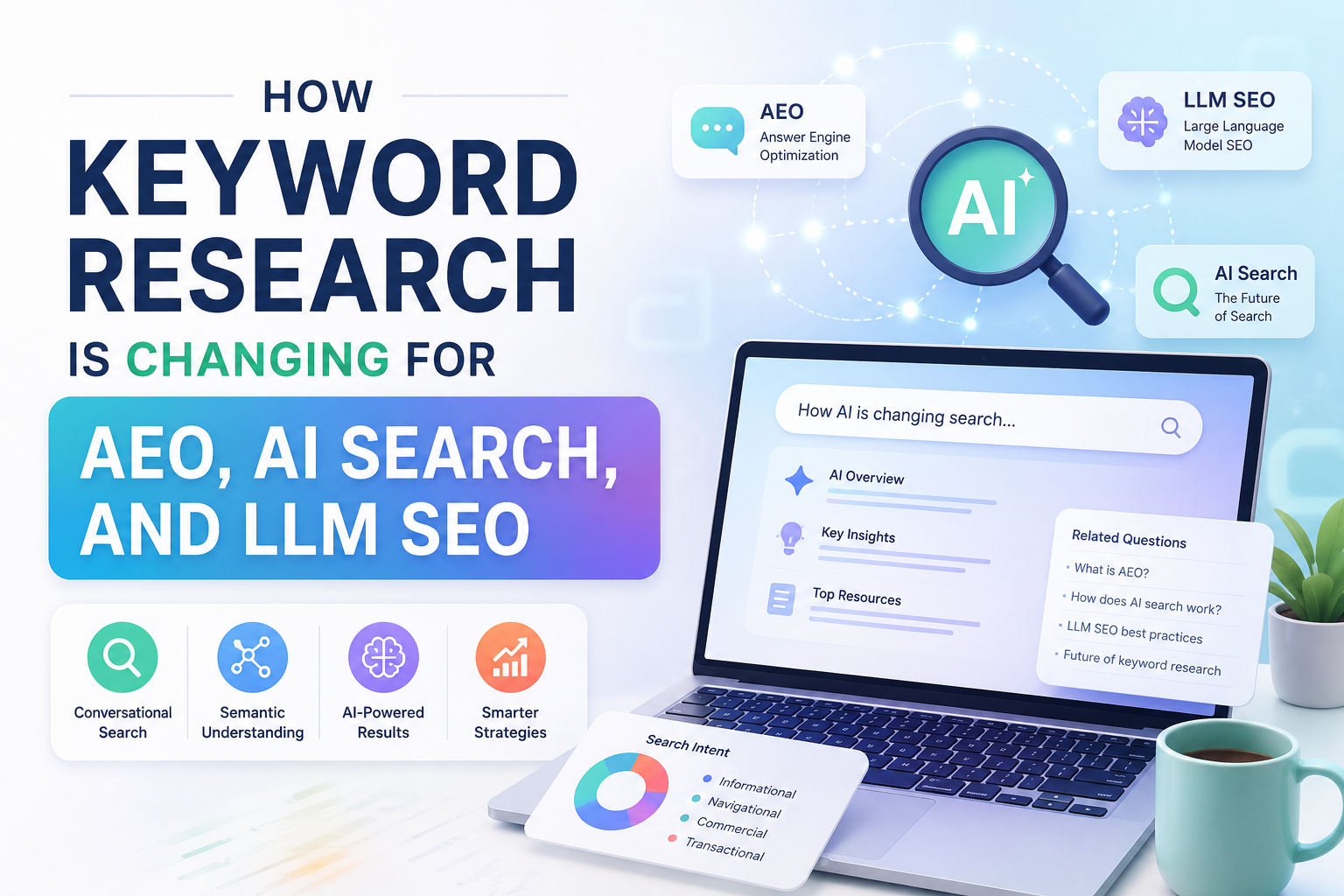
Keyword research is no longer just about finding high-volume terms and adding them to content. Search behavior is changing rapidly as AI Overviews, conversational search, and large language models reshape how people discover information online. Users now search through detailed questions, follow-up prompts, comparisons, and highly specific queries that traditional keyword strategies often fail to capture.
At the same time, Google’s AI-generated results are expanding beyond informational searches alone. AI Overviews increasingly appear for commercial and transactional queries, which means businesses can no longer rely only on ranking for a single keyword position. Visibility now depends more on semantic relevance, topical depth, entity relationships, and how well content aligns with conversational search intent.
This shift is also changing how keyword opportunities are discovered. Instead of relying only on search volume, modern SEO teams are analyzing:
- conversational queries,
- People Also Ask patterns,
- entity relationships,
- layered search intent,
- community discussions,
- and emerging AI search behavior.
In many cases, the goal is no longer just to rank in traditional search results. Content also needs to be relevant enough for AI systems to retrieve, summarize, and reference within AI-powered search experiences.
In this guide, we’ll explore the best keyword research tools for AEO and LLM SEO, how modern AI-search keyword research works, and how to uncover conversational, high-intent queries aligned with AI Overviews, semantic search, and LLM-driven discovery.
Why Traditional Keyword Research Is Changing

For years, SEO teams focused heavily on search volume, keyword density, and ranking pages for specific phrases. That approach still matters, but search engines now evaluate content in a much broader way.
Google’s systems increasingly focus on meaning, context, search intent, and topic relationships instead of relying only on exact-match keywords. Queries such as “best keyword tools for AI SEO” and “tools for AI search optimization” use different wording, but they often reflect the same underlying intent. Modern search systems are becoming better at understanding these semantic relationships.
Search behavior is also changing. Many users now search through detailed questions, conversational prompts, and follow-up queries instead of fragmented keyword phrases. This shift continues to grow alongside AI Overviews, voice search, and AI assistants that encourage more natural language interactions.
As AI-generated answers become more common in search results, visibility is no longer limited to blue-link rankings alone. Content also needs enough topical relevance, entity clarity, and contextual depth to be retrieved or referenced within AI-generated summaries. Research found that AI overviews contributed to higher impressions across many search categories while reducing click-through rates in some cases, showing how visibility patterns are evolving.
This shift is also changing how SEO teams approach keyword research. Instead of focusing only on isolated keywords, many teams now analyze:
- semantic relationships between topics,
- conversational search behavior,
- user intent across different stages of the journey,
- entity associations,
- community discussions,
- and real user questions from platforms like Reddit and Google Search.
Modern keyword research now focuses less on isolated keywords and more on understanding how people search, compare options, ask questions, and explore topics across AI-powered search experiences.
What Makes Keyword Research Different for AEO and LLM SEO
Traditional SEO keyword research focused heavily on finding exact keywords with strong search volume and ranking pages for those phrases. AEO and LLM SEO still rely on keyword research, but the focus has shifted toward understanding how search systems interpret questions, entities, topics, and conversational intent.
Search queries are also becoming longer and more conversational. Instead of searching with short phrases like “keyword research tools,” users now ask questions such as “What are the best keyword research tools for AI overviews?” or “How to find conversational search queries for LLM SEO?” These searches often reveal stronger intent and clearer context.
Modern search systems also analyze relationships between topics instead of treating every keyword as an isolated phrase. Queries with different wording may still lead to similar AI-generated answers because the underlying intent remains closely connected. This is one reason entity relationships and topical coverage matter more in AEO and LLM SEO workflows.
Another major shift is the growth of multi-intent search journeys. Users often move through connected searches, follow-up questions, and fan-out queries before making a decision. Someone researching “AI SEO tools” may later search for:
- “best keyword research tools for AI search”
- “how AI Overviews affect SEO”
- “Semrush vs Ahrefs for AI SEO”
Modern keyword research needs to account for these connected search paths instead of focusing only on isolated keywords.
In many cases, content is no longer evaluated only for ranking potential. Search systems also assess whether information is clear, contextually relevant, and useful enough to summarize within AI-generated answers and conversational search experiences.
Here is a simple comparison between traditional SEO keyword research and modern AEO/LLM SEO workflows:
| Traditional SEO | AEO and LLM SEO |
| Exact keywords | Conversational intent |
| Search volume | Semantic relevance |
| SERP rankings | AI retrieval visibility |
| Single keyword focus | Topic and entity coverage |
| Isolated search terms | Connected search journeys |
| Blue-link optimization | AI-generated answer visibility |
Traditional SEO still matters. Search volume, rankings, and keyword targeting remain useful. The difference is that modern keyword research now combines traditional SEO data with conversational intent analysis, semantic relationships, entity research, and AI search behavior.
What to Look for in a Keyword Research Tool for AI Search

Traditional keyword tools were designed mainly around search volume, rankings, and keyword difficulty scores. Those metrics still matter, but modern AI search workflows require deeper insights into how people search, how topics connect, and how search systems interpret intent.
A strong keyword research tool for AEO and LLM SEO should help uncover conversational search behavior, semantic relationships, and emerging query patterns instead of only generating keyword variations.
Question and Conversational Query Discovery
Modern search behavior increasingly looks like conversations. Users ask detailed questions, compare options, and explore follow-up searches instead of typing only short keyword phrases.
Good keyword research tools should help identify the following:
- question-based searches,
- long-tail conversational queries,
- follow-up search patterns,
- and natural-language phrasing.
This is especially useful for AI Overviews, voice search, and question-driven search experiences.
People Also Ask and SERP Analysis
People Also Ask data helps uncover how users expand searches around a topic. It also reveals connected questions and fan-out query patterns that traditional keyword lists often miss.
Strong SERP analysis features can also help identify:
- featured snippets,
- AI Overview visibility,
- related searches,
- and other search result features connected to user intent.
Entity and Topic Relationship Insights
Modern search systems evaluate relationships between topics instead of treating keywords as isolated phrases. A strong tool should help identify related entities, supporting subtopics, and broader topic connections around a search query.
This helps build stronger topical coverage and semantic relevance across content clusters.
Search Intent Insights
Search volume alone does not explain why someone searches for a query. Good keyword research tools should help identify whether a search reflects the following:
- informational intent,
- commercial investigation,
- transactional intent,
- or comparison-driven behavior.
This becomes increasingly important as AI-generated search experiences expand into commercial and decision-focused queries.
Content Clustering Support
AI search visibility often depends on broader topical depth instead of isolated keyword targeting. Tools with clustering features help organize related queries into connected topic groups.
This helps SEO teams build stronger content structures, improve internal linking, and create broader topic coverage around important search themes.
AI Overview and SERP Visibility Opportunities
Modern SEO workflows increasingly track visibility beyond blue-link rankings alone. Some tools now help identify queries that trigger AI Overviews, featured snippets, or other AI-driven search features.
This can help SEO teams understand where conversational and answer-focused content may have stronger visibility opportunities.
Trend and Emerging Topic Detection
Search behavior changes quickly, especially across AI-driven search environments. Strong keyword tools should help identify:
- rising search trends,
- emerging topics,
- new conversational phrasing,
- and evolving query patterns.
This is especially useful for discovering early-stage content opportunities before search behavior becomes highly competitive.
The best keyword research tools for AEO and LLM SEO do more than generate keyword ideas. They help uncover intent, topic relationships, conversational behavior, and AI-search visibility opportunities that traditional keyword workflows often overlook.
Best Keyword Research Tools for AEO and LLM SEO

Modern AI-search keyword research is no longer just about finding high-volume keywords. Search systems increasingly evaluate:
- conversational intent,
- follow-up questions,
- topic relationships,
- and broader informational relevance.
That is why advanced AEO and LLM SEO workflows rarely rely on a single tool. Different platforms reveal different layers of search behavior and user intent.
Some tools help uncover how people naturally phrase questions. Others reveal connected searches, hidden informational gaps, or patterns inside AI-generated answers.
The tools below are most useful when they are treated as research intelligence sources rather than simple keyword databases.
Semrush—Best for Understanding Search Intent and SERP Patterns
Semrush is especially useful for identifying how Google groups related searches around broader topics and intent patterns. Instead of using Semrush only for keyword volume, advanced workflows often combine:
- Keyword Magic Tool research,
- intent filters,
- SERP feature tracking,
- and topic clustering
to identify searches connected to: - featured snippets,
- People Also Ask results,
- and AI-generated search features.
How to Use Semrush for AEO and LLM SEO Research
- Start with a broad topic like “AI SEO tools.”
- Analyze question-based searches and informational modifiers.
- Compare SERP features across related keywords.
- Group overlapping searches into broader topic clusters.
The goal is not simply to collect more keywords. It is to understand how search systems connect related intent.
For example, if several keyword variations repeatedly trigger similar SERPs or AI-generated summaries, Google may interpret those searches as part of the same broader topic.
Modifiers like:
- “best”
- “vs”
- “how to”
- and “for beginners”It
can also reveal different stages of user research.
These patterns often help identify:
- FAQ opportunities,
- comparison content,
- missing supporting topics,
- and stronger topical coverage opportunities.
Ahrefs — Best for Finding Related Topics Users Explore Together
Ahrefs is particularly useful for discovering how smaller keyword variations connect to broader informational themes. Its Parent Topic and Questions reports help uncover searches users commonly explore before or after a core query.
How to Use Ahrefs for AEO and LLM SEO Research
- Enter a broad topic into Keywords Explorer.
- Review the Questions report for conversational searches.
- Analyze parent topics connected to those searches.
- Compare SERP overlap between related keywords.
One of the strongest signals inside Ahrefs is repeated SERP overlap.
For example, if multiple long-tail searches repeatedly lead to highly similar results, those searches may represent the following:
- related informational needs,
- connected search journeys,
- or closely linked topics.
This can help uncover the following:
- missing supporting pages,
- deeper educational content,
- and broader topic relationships
Google Search Console — Best for Discovering Real Conversational Searches
Google Search Console has become one of the most valuable tools for AI-search research because it reveals how real users already discover your content.
Many long-tail searches inside Search Console reflect:
- conversational phrasing,
- comparison behavior,
- implementation questions,
- and emerging informational intent
before those patterns appear clearly in traditional keyword tools.
How to Use Google Search Console for AEO and LLM SEO Research
- Open the Performance report.
- Filter queries by impressions.
- Look for long-tail searches and question-style phrasing.
- Compare high-impression queries with lower CTR.
The most useful signals often come from:
- rising conversational searches,
- exploratory wording,
- and queries generating impressions without strong engagement.
These patterns may suggest users are researching a topic but not yet finding sufficiently direct or helpful answers.
This can reveal opportunities for:
- stronger FAQs,
- clearer answer formatting,
- supporting educational sections,
- and better intent alignment.
AlsoAsked — Best for Follow-Up Questions and Query Fan-Out
AlsoAsked helps visualize how users expand searches through connected follow-up questions. This is especially useful because AI-powered search experiences increasingly encourage conversational refinement instead of one-time searches.
How to Use AlsoAsked for AEO Research
- Start with a broad informational topic.
- Analyze how questions branch into:
- comparisons,
- troubleshooting,
- tutorials,
- and implementation searches.
- Look for repeated patterns across multiple branches.
Repeated follow-up patterns often reveal how users move deeper into research.
For example, if many branches repeatedly focus on:
- comparisons,
- troubleshooting,
- or alternatives,
Those themes may represent important supporting topics connected to the main query.
These insights can help build:
- FAQ sections,
- supporting cluster pages,
- comparison content,
- and conversational, answer-focused content.
AnswerThePublic — Best for Natural-Language Search Discovery
AnswerThePublic is useful for uncovering how users naturally phrase informational searches. Instead of focusing mainly on keyword variations, it surfaces:
- “how” searches,
- “why” questions,
- comparisons,
- and voice-search style phrasing.
How to Use AnswerThePublic for AI Search Research
- Enter a broad topic or industry phrase.
- Analyze:
- “how”
- “why”
- “vs”
- and comparison-style searches.
- Identify repeated informational patterns and modifiers.
The real value is understanding how users phrase informational intent naturally.
For example:
- “how to”
searches often signal implementation intent,
while: - “vs”
Queries usually indicate evaluation or comparison behavior.
These patterns can help uncover:
- hidden informational needs,
- conversational phrasing,
- and supporting search journeys
Google Autocomplete and People Also Ask — Best for Topic Expansion and Emerging Intent
Google Autocomplete and People Also Ask remain some of the most useful free sources for understanding evolving search behavior directly from user activity.
These features frequently reveal:
- emerging conversational phrasing,
- connected search paths,
- recurring questions,
- and supporting informational themes.
How to Use Autocomplete and People Also Ask for AEO Research
- Search a broad topic directly in Google.
- Analyze autocomplete suggestions before submitting the search.
- Expand People Also Ask questions repeatedly.
- Group recurring questions into related themes.
Repeated People Also Ask patterns often reveal how Google expands a topic across connected searches.
For example, if multiple PAA questions repeatedly focus on:
- troubleshooting,
- beginner concerns,
- comparisons,
- or implementation,
Those themes represent informational areas strongly associated with the main topic.
This can help uncover the following:
- missing subtopics,
- answer-focused opportunities,
- and conversational search paths
before relying on keyword tools alone.
Reddit and Community Platforms — Best for Hidden Intent and Real User Language
Reddit and similar community platforms have become increasingly valuable for AI-search research because they expose natural language, frustrations, comparisons, and hidden informational intent that traditional SEO tools often miss.
Many conversational AI prompts resemble how users naturally ask questions inside forums rather than how they type traditional keyword phrases.
How to Use Reddit for AEO and LLM SEO Research
- Search discussions related to your topic.
- Analyze repeated wording, frustrations, and comparisons that users mention naturally.
- Look for recurring informational gaps and emotional language.
The strongest insights often come from repeated frustrations and comparison behavior.
For example, if users repeatedly mention:
- confusion,
- unclear explanations,
- missing examples,
- or comparison problems,
Those discussions may reveal informational gaps that existing content is not solving effectively.
These patterns can help improve:
- FAQs,
- comparison sections,
- educational content,
- and answer-focused topic coverage.
Perplexity and AI Search Engines — Best for Understanding Retrieval and Citation Patterns
Perplexity AI and other AI search engines help SEO teams observe how AI systems structure responses, connect entities, and surface sources across conversational searches.
Instead of focusing only on rankings, these platforms help reveal:
- recurring citations,
- answer structures,
- connected entities,
- and follow-up prompts.
How to Use Perplexity for AI Search Research
- Search broad informational queries related to your niche.
- Study which sources appear repeatedly across responses.
- Analyze how answers are structured and summarized.
- Observe follow-up prompts and connected search paths.
The goal is not to “hack” AI rankings. It is to understand retrieval and informational patterns.
For example, if certain domains repeatedly appear across related conversational searches, those sources may consistently provide the following:
- strong topical clarity,
- trusted informational depth,
- useful structure,
- or highly relevant entity relationships.
Modern AEO and LLM SEO research works best when these tools are combined. Traditional SEO platforms, conversational query tools, community discussions, and AI search engines each reveal different dimensions of search behavior that together create a much deeper understanding of how people search AI-powered environments.

How to Find Conversational Queries for AI Search
Finding conversational queries for AI search is no longer just about collecting long-tail keywords. Modern search journeys are increasingly conversational, comparison-driven, and multi-step. Users rarely stop at one search anymore. They refine questions, compare solutions, troubleshoot issues, and continue exploring connected topics through follow-up searches.
For example, a search journey may begin with:
- “keyword research”
Then naturally expand into the following:
- “Best keyword research tools”
- “Best Keyword Research Tools for AI Overviews”
- “How to find AI search queries”
These searches are connected. They reflect evolving intent and deeper informational exploration around the same topic.
Start With a Core Topic
Begin with a broad topic connected to your audience, niche, or business problem.
Examples:
- AI SEO
- conversational search
- AI Overviews
- keyword research
- LLM SEO
At this stage, focus on identifying the broader informational theme instead of chasing highly specific keyword variations immediately.
Expand Through Query Refinement
Use Google Autocomplete, People Also Ask, Reddit discussions, and community forums to observe how users naturally expand on a topic.
For example:
- “AI SEO tools”
may evolve into: - “best AI SEO tools for AI Overviews”
- “Semrush vs Ahrefs for AI SEO”
- “why AI search reduces traffic”
- “how to improve AI visibility”
This process reveals:
- comparison behavior,
- troubleshooting intent,
- implementation questions,
- and recurring informational concerns.
One conversational query can naturally expand into multiple search paths across the same topic ecosystem.
Analyze Real User Language
Google Search Console is especially valuable because it exposes how users already discover your content naturally. Instead of focusing only on clicks, analyze the following:
- long-tail impressions,
- question-style searches,
- comparison modifiers,
- and conversational phrasing.
Many emerging conversational patterns appear in Search Console and community discussions long before they become obvious in traditional keyword databases.
Group Queries by Intent and Entities
After collecting conversational searches, organize them by:
- intent,
- entities,
- and connected informational themes.
For example:
- “best keyword research tools” → comparison intent
- “how to optimize for AI Overviews” → implementation intent
- “why is my content not showing in AI search?” → troubleshooting intent
This helps reveal how users move naturally between the following:
- exploration,
- comparison,
- implementation,
- and refinement
during the same search journey.
Build Connected Topic Clusters
Once conversational patterns become clear, organize them into broader semantic topic clusters.
For example:
- conversational keyword research
- AI Overview optimization
- entity SEO
- AI-search visibility
- semantic clustering
These connected topics help create stronger contextual coverage and clearer informational pathways across the content ecosystem.
Identify AI Overview Opportunities
Some conversational searches are more likely to trigger:
- Google AI Overviews,
- featured snippets,
- People Also Ask results,
- and AI-generated summaries.
These often include:
- question-based searches,
- comparisons,
- implementation queries,
- and troubleshooting-focused searches.
The biggest shift is that conversational keyword research is becoming less about isolated keywords and more about understanding how informational journeys evolve across connected AI-search experiences.
How to Build Semantic Keyword Clusters for LLM SEO

Semantic keyword clustering for LLM SEO is no longer just about grouping similar keyword variations together. Modern AI-powered search systems increasingly interpret content through the following:
- topic relationships,
- supporting entities,
- internal context,
- and broader topical structure.
That means isolated keyword pages are becoming less effective than connected topic ecosystems that reinforce meaning across multiple related pages.
For example, a traditional clustering approach may group the following:
- AI SEO
- AI SEO tools
- AI SEO software
But a stronger semantic cluster for LLM SEO may organize content around:
- conversational search,
- AI Overviews,
- semantic search,
- entity SEO,
- topical authority,
- and AI-search visibility.
These connected topics help create a clearer topical structure around the broader subject instead of relying only on repeated keyword variations.
Start With a Core Topic Structure
Strong semantic clusters usually begin with a broad informational pillar rather than multiple narrow keyword targets.
For example:
- AI keyword research
can become the central topic connected to:
- semantic clustering,
- conversational search,
- AI Overview optimization,
- entity SEO,
- and AI-search visibility.
This creates stronger topical organization than publishing isolated pages targeting slight keyword variations independently.
Build Supporting Topic Layers
Once the main topic is established, expand the cluster using:
- supporting educational topics,
- implementation content,
- comparison pages,
- troubleshooting content,
- and related informational themes.
For example:
- conversational keyword research
may connect naturally to:
- query fan-out,
- semantic mapping,
- AI Overview optimization,
- and People Also Ask analysis.
These supporting layers help reinforce how related topics connect across the broader content ecosystem.
Use Entity Relationships to Strengthen Context
Modern AI systems increasingly rely on entities to understand how:
- tools,
- technologies,
- concepts,
- and brands
connect contextually.
For example:
- AI-search optimization
may naturally relate to:
- Google Search Console,
- Semrush,
- AI Overviews,
- and semantic search.
These entity relationships help reinforce topical meaning more clearly than repeated keyword usage alone.
Connect Clusters Through Internal Linking
Internal linking helps reinforce relationships between connected topics across the website.
For example, a page about:
- semantic clustering
may internally support pages discussing the following:
- conversational search,
- AI Overview optimization,
- entity SEO,
- and topical authority.
This creates clearer informational pathways and helps search systems interpret how related concepts support the broader topic ecosystem.
The bigger shift is that semantic clustering is becoming less about keyword grouping and more about building connected informational structures that help AI systems interpret topical meaning, relationships, and content relevance more clearly across AI-powered search environments.
Common Mistakes in AEO Keyword Research
Many AEO keyword research mistakes happen because websites are still optimizing for traditional ranking behavior while search itself is becoming more conversational, contextual, and retrieval-driven. The result is content that may rank for a keyword but still struggles inside AI-generated search experiences.
Focusing Only on Search Volume
One of the biggest mistakes is treating high search volume as the main signal of keyword value. Broad keywords may generate visibility, but they often reveal very little about what users actually want. In many AI-search environments, conversational and intent-specific searches usually carry stronger informational alignment because users increasingly refine queries while exploring a topic.
Over-Optimizing Exact-Match Keywords
A growing amount of AI-search content still reads like keyword expansion instead of useful information. Exact-match phrases are forced unnaturally into headings, subheadings, and paragraphs, even when the writing loses clarity. The page targets the keyword correctly, but the surrounding context often feels shallow or repetitive.
Treating AI SEO Like Traditional SEO Only
Many websites still optimize mainly for rankings, keyword placement, and search demand without building enough topical depth around the subject. That gap becomes more visible inside AI-generated answers where retrieval systems increasingly evaluate how clearly the content explains the topic, connects related ideas, and supports broader informational intent.
Ignoring Real User Language
Another common mistake is relying too heavily on SEO tools while ignoring how people actually talk and search. Conversational patterns often appear first through:
- Google Search Console,
- Reddit discussions,
- support forums,
- and People Also Ask results.
These sources usually reveal stronger insight into evolving search behavior than keyword databases alone.
The bigger shift is that modern keyword research is becoming less about isolated phrase targeting and more about understanding how conversational intent, topic relationships, and informational journeys connect across AI-driven search experiences.
Future of Keyword Research in AI Search

This broader evolution is also shaping how LLM SEO strategies approach conversational discovery, retrieval visibility, and topic relationships. For years, SEO strategies focused heavily on:
- exact-match phrases,
- search volume,
- and ranking opportunities.
Now, AI-powered search experiences are shifting visibility toward:
- conversational understanding,
- retrieval confidence,
- topic relationships,
- and broader contextual interpretation.
The biggest change is that search is becoming less dependent on isolated queries and more influenced by connected informational exploration. Users increasingly refine searches through:
- follow-up questions,
- comparisons,
- troubleshooting,
- and conversational discovery
across the same research journey.
As a result, future keyword research will likely focus more on understanding:
- how intent evolves,
- how topics connect,
- and how AI systems interpret meaning across related searches.
AI Retrieval Systems Will Reshape Visibility
Traditional search primarily ranked webpages. AI-powered search experiences increasingly synthesize information, generate summaries, and retrieve supporting context from multiple sources simultaneously. This changes how visibility works.
Some pages may still rank traditionally while struggling to appear inside:
- AI-generated answers,
- conversational search interfaces,
- and retrieval-driven search systems.
Future visibility will likely depend more on:
- informational clarity,
- topical reinforcement,
- retrieval relevance,
- and contextual trust
instead of keyword repetition alone.
Entity Relationships Will Become More Important
Modern AI systems increasingly interpret topics through relationships between:
- entities,
- concepts,
- technologies,
- and supporting context.
That means future keyword research will likely move further beyond isolated keyword targeting and deeper into:
- topic ecosystems,
- entity mapping,
- and connected informational structures.
The stronger the relationships between related topics, the easier it becomes for AI systems to interpret broader meaning around the subject.
Multi-Modal Search Will Expand Search Behavior
Search is also evolving beyond traditional text queries. AI-powered discovery increasingly combines:
- text,
- voice,
- video,
- images,
- and conversational interfaces
within the same search experience.
As a result, keyword research may increasingly involve understanding:
- conversational prompts,
- visual intent,
- cross-platform behavior,
- and multi-format discovery patterns.
This expands how search intent is expressed across different interfaces instead of replacing traditional keyword research entirely.
Topical Depth and Trust Will Matter More
As AI-generated search experiences continue evolving, search systems increasingly need stronger signals to evaluate relevance, clarity, trustworthiness, and informational reliability. This broader shift also aligns closely with principles discussed in Google’s Search Quality Evaluator Guidelines.
- relevance,
- clarity,
- trustworthiness,
- and informational reliability.
That is one reason topical depth is becoming more important. Websites covering connected supporting topics often create stronger retrieval confidence than pages targeting isolated keyword opportunities without broader informational support.
The bigger shift is not that keywords are disappearing. It is that keyword research is evolving from phrase targeting into understanding how topics, entities, trust, and informational relationships connect across AI-powered search environments.
Final Thoughts
Traditional keyword research still matters, but search behavior and visibility models are evolving quickly. AI-powered search experiences are becoming more conversational, contextual, and entity-driven, which means keyword research is no longer only about targeting exact phrases or chasing search volume.
Modern AEO and LLM SEO workflows increasingly depend on understanding:
- conversational intent,
- semantic relationships,
- topical depth,
- and how users refine searches across connected informational journeys.
That is why the strongest strategies now combine:
- SEO tools,
- real-user query data,
- semantic clustering,
- and AI-search awareness
instead of relying only on isolated keyword targeting.
The bigger shift is not that keywords are disappearing. It is that keyword research is evolving from phrase targeting into contextual discovery built around conversational search behavior and connected topic ecosystems.
FAQs
What is keyword research for AEO and LLM SEO?
Keyword research for AEO and LLM SEO focuses on understanding conversational intent, semantic relationships, and contextual relevance instead of relying only on search volume. The goal is to help AI-powered search systems retrieve, interpret, and reference content across evolving conversational search journeys.
Are traditional SEO tools still useful for AI search optimization?
Yes, traditional SEO tools still matter, but the workflows are evolving. Platforms like Semrush, Ahrefs, and Google Search Console now help uncover conversational queries, semantic gaps, entity relationships, and AI-search visibility opportunities beyond traditional rankings alone.
Which tool is best for finding conversational search queries?
There is no single best tool for conversational query research. The strongest workflows usually combine Google Search Console, Reddit, People Also Ask, autocomplete data, AlsoAsked, and SEO platforms to identify real conversational search behavior and evolving intent patterns.
How do AI Overviews affect keyword research?
AI Overviews are shifting keyword research toward conversational intent, semantic relevance, and answer-focused content. Visibility increasingly depends on whether content provides enough contextual clarity and topical relevance for AI systems to retrieve and synthesize confidently.
What are semantic keyword clusters in LLM SEO?
Semantic keyword clusters help AI systems understand how related topics, entities, and informational intent connect across the same search journey. Instead of targeting isolated keyword variations, LLM SEO focuses more on contextual topic relationships and broader semantic coverage.
Can Google Search Console help with AEO research?
Yes, Google Search Console is valuable for AEO research because it reveals real user queries, conversational search patterns, long-tail impressions, and evolving informational behavior. It often exposes emerging AI-search trends before many third-party keyword tools detect them.
What is the difference between SEO keyword research and AEO keyword research?
Traditional SEO keyword research focuses more on rankings, search volume, and keyword targeting. AEO keyword research focuses more on conversational intent, semantic relationships, contextual relevance, and helping AI-powered systems retrieve or summarize information naturally.
Why are conversational queries important for AI search?
Conversational queries are important because modern AI-powered search systems increasingly interpret natural-language questions, follow-up searches, and intent refinement instead of isolated keyword phrases. These searches often reveal deeper informational intent and stronger contextual relevance.