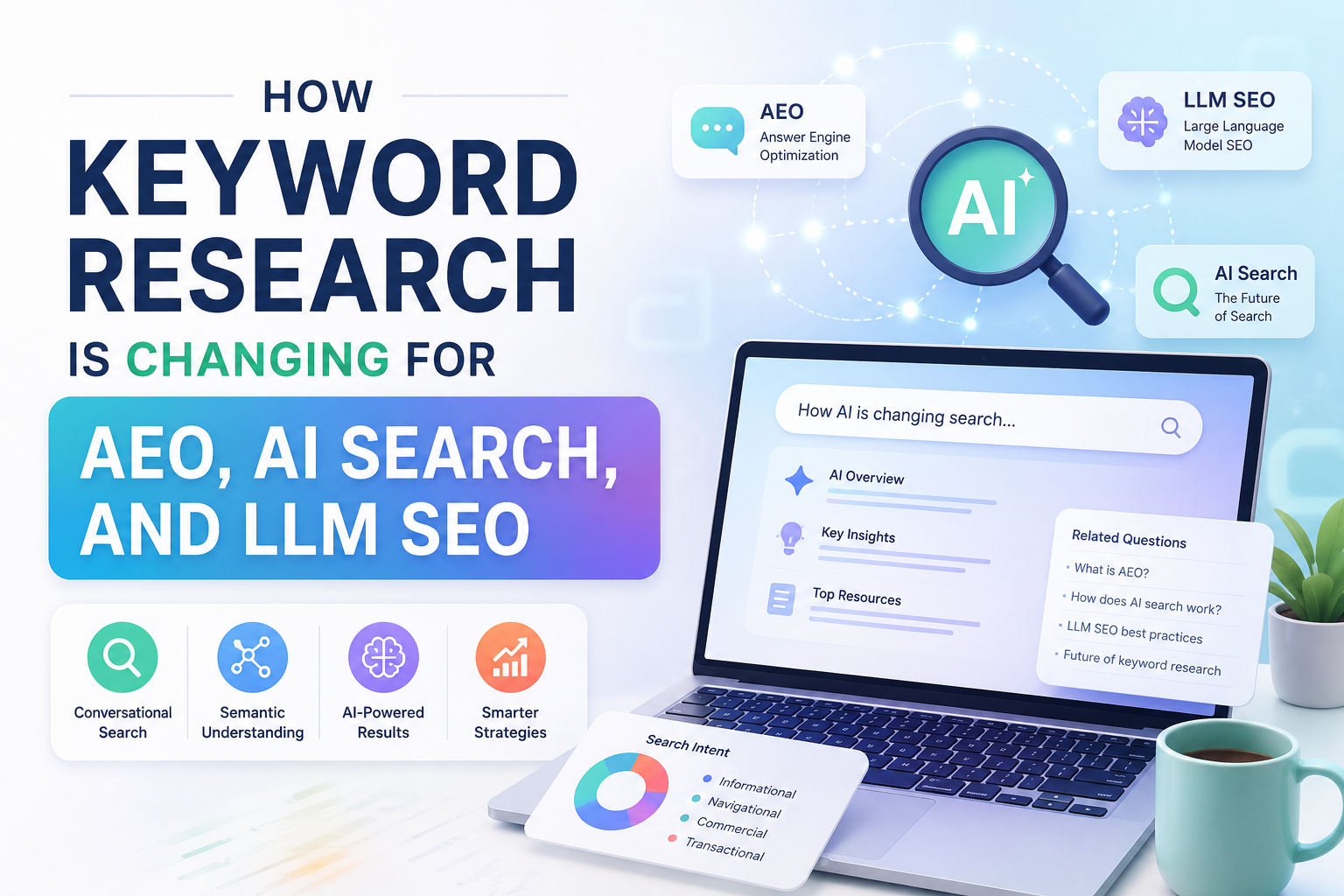
Tag: #AISEO

  • How Keyword Research Is Changing for AEO, AI Search, and LLM SEO

    How Keyword Research Is Changing for AEO, AI Search, and LLM SEO

    Keyword research is no longer just about finding high-volume terms and adding them to content. Search behavior is changing rapidly as AI Overviews, conversational search, and large language models reshape how people discover information online. Users now search through detailed questions, follow-up prompts, comparisons, and highly specific queries that traditional keyword strategies often fail to capture.

    At the same time, Google’s AI-generated results are expanding beyond informational searches alone. AI Overviews increasingly appear for commercial and transactional queries, which means businesses can no longer rely only on ranking for a single keyword position. Visibility now depends more on semantic relevance, topical depth, entity relationships, and how well content aligns with conversational search intent.

    This shift is also changing how keyword opportunities are discovered. Instead of relying only on search volume, modern SEO teams are analyzing:

    • conversational queries,
    • People Also Ask patterns,
    • entity relationships,
    • layered search intent,
    • community discussions,
    • and emerging AI search behavior.

    In many cases, the goal is no longer just to rank in traditional search results. Content also needs to be relevant enough for AI systems to retrieve, summarize, and reference within AI-powered search experiences.

    In this guide, we’ll explore the best keyword research tools for AEO and LLM SEO, how modern AI-search keyword research works, and how to uncover conversational, high-intent queries aligned with AI Overviews, semantic search, and LLM-driven discovery.

    Why Traditional Keyword Research Is Changing

    Keyword research for AEO and LLM SEO illustration showing AI-powered search, conversational queries, and semantic search optimization.

    For years, SEO teams focused heavily on search volume, keyword density, and ranking pages for specific phrases. That approach still matters, but search engines now evaluate content in a much broader way.

    Google’s systems increasingly focus on meaning, context, search intent, and topic relationships instead of relying only on exact-match keywords. Queries such as “best keyword tools for AI SEO” and “tools for AI search optimization” use different wording, but they often reflect the same underlying intent. Modern search systems are becoming better at understanding these semantic relationships.

    Search behavior is also changing. Many users now search through detailed questions, conversational prompts, and follow-up queries instead of fragmented keyword phrases. This shift continues to grow alongside AI Overviews, voice search, and AI assistants that encourage more natural language interactions.

    As AI-generated answers become more common in search results, visibility is no longer limited to blue-link rankings alone. Content also needs enough topical relevance, entity clarity, and contextual depth to be retrieved or referenced within AI-generated summaries. Research found that AI overviews contributed to higher impressions across many search categories while reducing click-through rates in some cases, showing how visibility patterns are evolving.

    This shift is also changing how SEO teams approach keyword research. Instead of focusing only on isolated keywords, many teams now analyze:

    • semantic relationships between topics,
    • conversational search behavior,
    • user intent across different stages of the journey,
    • entity associations,
    • community discussions,
    • and real user questions from platforms like Reddit and Google Search.

    Modern keyword research now focuses less on isolated keywords and more on understanding how people search, compare options, ask questions, and explore topics across AI-powered search experiences.

    What Makes Keyword Research Different for AEO and LLM SEO

    Traditional SEO keyword research focused heavily on finding exact keywords with strong search volume and ranking pages for those phrases. AEO and LLM SEO still rely on keyword research, but the focus has shifted toward understanding how search systems interpret questions, entities, topics, and conversational intent.

    Search queries are also becoming longer and more conversational. Instead of searching with short phrases like “keyword research tools,” users now ask questions such as “What are the best keyword research tools for AI overviews?” or “How to find conversational search queries for LLM SEO?” These searches often reveal stronger intent and clearer context.

    Modern search systems also analyze relationships between topics instead of treating every keyword as an isolated phrase. Queries with different wording may still lead to similar AI-generated answers because the underlying intent remains closely connected. This is one reason entity relationships and topical coverage matter more in AEO and LLM SEO workflows.

    Another major shift is the growth of multi-intent search journeys. Users often move through connected searches, follow-up questions, and fan-out queries before making a decision. Someone researching “AI SEO tools” may later search for:

    • “best keyword research tools for AI search”
    • “how AI Overviews affect SEO”
    • “Semrush vs Ahrefs for AI SEO”

    Modern keyword research needs to account for these connected search paths instead of focusing only on isolated keywords.

    In many cases, content is no longer evaluated only for ranking potential. Search systems also assess whether information is clear, contextually relevant, and useful enough to summarize within AI-generated answers and conversational search experiences.

    Here is a simple comparison between traditional SEO keyword research and modern AEO/LLM SEO workflows:

    Traditional SEOAEO and LLM SEO
    Exact keywordsConversational intent
    Search volumeSemantic relevance
    SERP rankingsAI retrieval visibility
    Single keyword focusTopic and entity coverage
    Isolated search termsConnected search journeys
    Blue-link optimizationAI-generated answer visibility

    Traditional SEO still matters. Search volume, rankings, and keyword targeting remain useful. The difference is that modern keyword research now combines traditional SEO data with conversational intent analysis, semantic relationships, entity research, and AI search behavior.

    What to Look for in a Keyword Research Tool for AI Search

    Keyword research tool for AI search illustration showing conversational query discovery, semantic analysis, AI Overview insights, and modern SEO workflows.

    Traditional keyword tools were designed mainly around search volume, rankings, and keyword difficulty scores. Those metrics still matter, but modern AI search workflows require deeper insights into how people search, how topics connect, and how search systems interpret intent.

    A strong keyword research tool for AEO and LLM SEO should help uncover conversational search behavior, semantic relationships, and emerging query patterns instead of only generating keyword variations.

    Question and Conversational Query Discovery

    Modern search behavior increasingly looks like conversations. Users ask detailed questions, compare options, and explore follow-up searches instead of typing only short keyword phrases.

    Good keyword research tools should help identify the following:

    • question-based searches,
    • long-tail conversational queries,
    • follow-up search patterns,
    • and natural-language phrasing.

    This is especially useful for AI Overviews, voice search, and question-driven search experiences.

    People Also Ask and SERP Analysis

    People Also Ask data helps uncover how users expand searches around a topic. It also reveals connected questions and fan-out query patterns that traditional keyword lists often miss.

    Strong SERP analysis features can also help identify:

    • featured snippets,
    • AI Overview visibility,
    • related searches,
    • and other search result features connected to user intent.

    Entity and Topic Relationship Insights

    Modern search systems evaluate relationships between topics instead of treating keywords as isolated phrases. A strong tool should help identify related entities, supporting subtopics, and broader topic connections around a search query.

    This helps build stronger topical coverage and semantic relevance across content clusters.

    Search Intent Insights

    Search volume alone does not explain why someone searches for a query. Good keyword research tools should help identify whether a search reflects the following:

    • informational intent,
    • commercial investigation,
    • transactional intent,
    • or comparison-driven behavior.

    This becomes increasingly important as AI-generated search experiences expand into commercial and decision-focused queries.

    Content Clustering Support

    AI search visibility often depends on broader topical depth instead of isolated keyword targeting. Tools with clustering features help organize related queries into connected topic groups.

    This helps SEO teams build stronger content structures, improve internal linking, and create broader topic coverage around important search themes.

    AI Overview and SERP Visibility Opportunities

    Modern SEO workflows increasingly track visibility beyond blue-link rankings alone. Some tools now help identify queries that trigger AI Overviews, featured snippets, or other AI-driven search features.

    This can help SEO teams understand where conversational and answer-focused content may have stronger visibility opportunities.

    Trend and Emerging Topic Detection

    Search behavior changes quickly, especially across AI-driven search environments. Strong keyword tools should help identify:

    • rising search trends,
    • emerging topics,
    • new conversational phrasing,
    • and evolving query patterns.

    This is especially useful for discovering early-stage content opportunities before search behavior becomes highly competitive.

    The best keyword research tools for AEO and LLM SEO do more than generate keyword ideas. They help uncover intent, topic relationships, conversational behavior, and AI-search visibility opportunities that traditional keyword workflows often overlook.

    Best Keyword Research Tools for AEO and LLM SEO

    Best keyword research tools for AEO and LLM SEO illustration featuring AI search analysis, conversational SEO research, semantic clustering, and modern keyword strategy tools.

    Modern AI-search keyword research is no longer just about finding high-volume keywords. Search systems increasingly evaluate:

    • conversational intent,
    • follow-up questions,
    • topic relationships,
    • and broader informational relevance.

    That is why advanced AEO and LLM SEO workflows rarely rely on a single tool. Different platforms reveal different layers of search behavior and user intent.

    Some tools help uncover how people naturally phrase questions. Others reveal connected searches, hidden informational gaps, or patterns inside AI-generated answers.

    The tools below are most useful when they are treated as research intelligence sources rather than simple keyword databases.

    Semrush—Best for Understanding Search Intent and SERP Patterns

    Semrush is especially useful for identifying how Google groups related searches around broader topics and intent patterns. Instead of using Semrush only for keyword volume, advanced workflows often combine:

    • Keyword Magic Tool research,
    • intent filters,
    • SERP feature tracking,
    • and topic clustering
      to identify searches connected to:
    • featured snippets,
    • People Also Ask results,
    • and AI-generated search features.

    How to Use Semrush for AEO and LLM SEO Research

    1. Start with a broad topic like “AI SEO tools.”
    2. Analyze question-based searches and informational modifiers.
    3. Compare SERP features across related keywords.
    4. Group overlapping searches into broader topic clusters.

    The goal is not simply to collect more keywords. It is to understand how search systems connect related intent.

    For example, if several keyword variations repeatedly trigger similar SERPs or AI-generated summaries, Google may interpret those searches as part of the same broader topic.

    Modifiers like:

    • “best”
    • “vs”
    • “how to”
    • and “for beginners”It
      can also reveal different stages of user research.

    These patterns often help identify:

    • FAQ opportunities,
    • comparison content,
    • missing supporting topics,
    • and stronger topical coverage opportunities.

    Ahrefs — Best for Finding Related Topics Users Explore Together

    Ahrefs is particularly useful for discovering how smaller keyword variations connect to broader informational themes. Its Parent Topic and Questions reports help uncover searches  users commonly explore before or after a core query.

    How to Use Ahrefs for AEO and LLM SEO Research

    1. Enter a broad topic into Keywords Explorer.
    2. Review the Questions report for conversational searches.
    3. Analyze parent topics connected to those searches.
    4. Compare SERP overlap between related keywords.

    One of the strongest signals inside Ahrefs is repeated SERP overlap.

    For example, if multiple long-tail searches repeatedly lead to highly similar results, those searches may represent the following:

    • related informational needs,
    • connected search journeys,
    • or closely linked topics.

    This can help uncover the following:

    • missing supporting pages,
    • deeper educational content,
    • and broader topic relationships

    Google Search Console — Best for Discovering Real Conversational Searches

    Google Search Console has become one of the most valuable tools for AI-search research because it reveals how real users already discover your content.

    Many long-tail searches inside Search Console reflect:

    • conversational phrasing,
    • comparison behavior,
    • implementation questions,
    • and emerging informational intent
      before those patterns appear clearly in traditional keyword tools.

    How to Use Google Search Console for AEO and LLM SEO Research

    1. Open the Performance report.
    2. Filter queries by impressions.
    3. Look for long-tail searches and question-style phrasing.
    4. Compare high-impression queries with lower CTR.

    The most useful signals often come from:

    • rising conversational searches,
    • exploratory wording,
    • and queries generating impressions without strong engagement.

    These patterns may suggest users are researching a topic but not yet finding sufficiently direct or helpful answers.

    This can reveal opportunities for:

    • stronger FAQs,
    • clearer answer formatting,
    • supporting educational sections,
    • and better intent alignment.

    AlsoAsked — Best for Follow-Up Questions and Query Fan-Out

    AlsoAsked helps visualize how users expand searches through connected follow-up questions. This is especially useful because AI-powered search experiences increasingly encourage conversational refinement instead of one-time searches.

    How to Use AlsoAsked for AEO Research

    1. Start with a broad informational topic.
    2. Analyze how questions branch into:
      • comparisons,
      • troubleshooting,
      • tutorials,
      • and implementation searches.
    3. Look for repeated patterns across multiple branches.

    Repeated follow-up patterns often reveal how users move deeper into research.

    For example, if many branches repeatedly focus on:

    • comparisons,
    • troubleshooting,
    • or alternatives,
      Those themes may represent important supporting topics connected to the main query.

    These insights can help build:

    • FAQ sections,
    • supporting cluster pages,
    • comparison content,
    • and conversational, answer-focused content.

    AnswerThePublic — Best for Natural-Language Search Discovery

    AnswerThePublic is useful for uncovering how users naturally phrase informational searches. Instead of focusing mainly on keyword variations, it surfaces:

    • “how” searches,
    • “why” questions,
    • comparisons,
    • and voice-search style phrasing.

    How to Use AnswerThePublic for AI Search Research

    1. Enter a broad topic or industry phrase.
    2. Analyze:
      • “how”
      • “why”
      • “vs”
      • and comparison-style searches.
    3. Identify repeated informational patterns and modifiers.

    The real value is understanding how users phrase informational intent naturally.

    For example:

    • “how to”
      searches often signal implementation intent,
      while:
    • “vs”
      Queries usually indicate evaluation or comparison behavior.

    These patterns can help uncover:

    • hidden informational needs,
    • conversational phrasing,
    • and supporting search journeys

    Google Autocomplete and People Also Ask — Best for Topic Expansion and Emerging Intent

    Google Autocomplete and People Also Ask remain some of the most useful free sources for understanding evolving search behavior directly from user activity.

    These features frequently reveal:

    • emerging conversational phrasing,
    • connected search paths,
    • recurring questions,
    • and supporting informational themes.

    How to Use Autocomplete and People Also Ask for AEO Research

    1. Search a broad topic directly in Google.
    2. Analyze autocomplete suggestions before submitting the search.
    3. Expand People Also Ask questions repeatedly.
    4. Group recurring questions into related themes.

    Repeated People Also Ask patterns often reveal how Google expands a topic across connected searches.

    For example, if multiple PAA questions repeatedly focus on:

    • troubleshooting,
    • beginner concerns,
    • comparisons,
    • or implementation,
      Those themes represent informational areas strongly associated with the main topic.

    This can help uncover the following:

    • missing subtopics,
    • answer-focused opportunities,
    • and conversational search paths
      before relying on keyword tools alone.

    Reddit and Community Platforms — Best for Hidden Intent and Real User Language

    Reddit and similar community platforms have become increasingly valuable for AI-search research because they expose natural language, frustrations, comparisons, and hidden informational intent that traditional SEO tools often miss.

    Many conversational AI prompts resemble how users naturally ask questions inside forums rather than how they type traditional keyword phrases.

    How to Use Reddit for AEO and LLM SEO Research

    1. Search discussions related to your topic.
    2. Analyze repeated wording, frustrations, and comparisons that users mention naturally.
    3. Look for recurring informational gaps and emotional language.

    The strongest insights often come from repeated frustrations and comparison behavior.

    For example, if users repeatedly mention:

    • confusion,
    • unclear explanations,
    • missing examples,
    • or comparison problems,
      Those discussions may reveal informational gaps that existing content is not solving effectively.

    These patterns can help improve:

    • FAQs,
    • comparison sections,
    • educational content,
    • and answer-focused topic coverage.

    Perplexity and AI Search Engines — Best for Understanding Retrieval and Citation Patterns

    Perplexity AI and other AI search engines help SEO teams observe how AI systems structure responses, connect entities, and surface sources across conversational searches.

    Instead of focusing only on rankings, these platforms help reveal:

    • recurring citations,
    • answer structures,
    • connected entities,
    • and follow-up prompts.

    How to Use Perplexity for AI Search Research

    1. Search broad informational queries related to your niche.
    2. Study which sources appear repeatedly across responses.
    3. Analyze how answers are structured and summarized.
    4. Observe follow-up prompts and connected search paths.

    The goal is not to “hack” AI rankings. It is to understand retrieval and informational patterns.

    For example, if certain domains repeatedly appear across related conversational searches, those sources may consistently provide the following:

    • strong topical clarity,
    • trusted informational depth,
    • useful structure,
    • or highly relevant entity relationships.

    Modern AEO and LLM SEO research works best when these tools are combined. Traditional SEO platforms, conversational query tools, community discussions, and AI search engines each reveal different dimensions of search behavior that together create a much deeper understanding of how people search AI-powered environments.

    AI-powered SEO and content strategy CTA banner with Connect With Us button for AEO, AI search, and LLM SEO services.

    How to Find Conversational Queries for AI Search

    Finding conversational queries for AI search is no longer just about collecting long-tail keywords. Modern search journeys are increasingly conversational, comparison-driven, and multi-step. Users rarely stop at one search anymore. They refine questions, compare solutions, troubleshoot issues, and continue exploring connected topics through follow-up searches.

    For example, a search journey may begin with:

    • “keyword research”

    Then naturally expand into the following:

    • “Best keyword research tools”
    • “Best Keyword Research Tools for AI Overviews”
    • “How to find AI search queries”

    These searches are connected. They reflect evolving intent and deeper informational exploration around the same topic.

    Start With a Core Topic

    Begin with a broad topic connected to your audience, niche, or business problem.

    Examples:

    • AI SEO
    • conversational search
    • AI Overviews
    • keyword research
    • LLM SEO

    At this stage, focus on identifying the broader informational theme instead of chasing highly specific keyword variations immediately.

    Expand Through Query Refinement

    Use Google Autocomplete, People Also Ask, Reddit discussions, and community forums to observe how users naturally expand on a topic.

    For example:

    • “AI SEO tools”
      may evolve into:
    • “best AI SEO tools for AI Overviews”
    • “Semrush vs Ahrefs for AI SEO”
    • “why AI search reduces traffic”
    • “how to improve AI visibility”

    This process reveals:

    • comparison behavior,
    • troubleshooting intent,
    • implementation questions,
    • and recurring informational concerns.

    One conversational query can naturally expand into multiple search paths across the same topic ecosystem.

    Analyze Real User Language

    Google Search Console is especially valuable because it exposes how users already discover your content naturally. Instead of focusing only on clicks, analyze the following:

    • long-tail impressions,
    • question-style searches,
    • comparison modifiers,
    • and conversational phrasing.

    Many emerging conversational patterns appear in Search Console and community discussions long before they become obvious in traditional keyword databases.

    Group Queries by Intent and Entities

    After collecting conversational searches, organize them by:

    • intent,
    • entities,
    • and connected informational themes.

    For example:

    • “best keyword research tools” → comparison intent
    • “how to optimize for AI Overviews” → implementation intent
    • “why is my content not showing in AI search?” → troubleshooting intent

    This helps reveal how users move naturally between the following:

    • exploration,
    • comparison,
    • implementation,
    • and refinement
      during the same search journey.

    Build Connected Topic Clusters

    Once conversational patterns become clear, organize them into broader semantic topic clusters.

    For example:

    • conversational keyword research
    • AI Overview optimization
    • entity SEO
    • AI-search visibility
    • semantic clustering

    These connected topics help create stronger contextual coverage and clearer informational pathways across the content ecosystem.

    Identify AI Overview Opportunities

    Some conversational searches are more likely to trigger:

    • Google AI Overviews,
    • featured snippets,
    • People Also Ask results,
    • and AI-generated summaries. 

    These often include:

    • question-based searches,
    • comparisons,
    • implementation queries,
    • and troubleshooting-focused searches.

    The biggest shift is that conversational keyword research is becoming less about isolated keywords and more about understanding how informational journeys evolve across connected AI-search experiences.

    How to Build Semantic Keyword Clusters for LLM SEO

    Semantic keyword clustering for LLM SEO illustration showing topic relationships, entity SEO, conversational search, and connected AI search content clusters.

    Semantic keyword clustering for LLM SEO is no longer just about grouping similar keyword variations together. Modern AI-powered search systems increasingly interpret content through the following:

    • topic relationships,
    • supporting entities,
    • internal context,
    • and broader topical structure.

    That means isolated keyword pages are becoming less effective than connected topic ecosystems that reinforce meaning across multiple related pages.

    For example, a traditional clustering approach may group the following:

    • AI SEO
    • AI SEO tools
    • AI SEO software

    But a stronger semantic cluster for LLM SEO may organize content around:

    • conversational search,
    • AI Overviews,
    • semantic search,
    • entity SEO,
    • topical authority,
    • and AI-search visibility.

    These connected topics help create a clearer topical structure around the broader subject instead of relying only on repeated keyword variations.

    Start With a Core Topic Structure

    Strong semantic clusters usually begin with a broad informational pillar rather than multiple narrow keyword targets.

    For example:

    • AI keyword research

    can become the central topic connected to:

    • semantic clustering,
    • conversational search,
    • AI Overview optimization,
    • entity SEO,
    • and AI-search visibility.

    This creates stronger topical organization than publishing isolated pages targeting slight keyword variations independently.

    Build Supporting Topic Layers

    Once the main topic is established, expand the cluster using:

    • supporting educational topics,
    • implementation content,
    • comparison pages,
    • troubleshooting content,
    • and related informational themes.

    For example:

    • conversational keyword research

    may connect naturally to:

    • query fan-out,
    • semantic mapping,
    • AI Overview optimization,
    • and People Also Ask analysis.

    These supporting layers help reinforce how related topics connect across the broader content ecosystem.

    Use Entity Relationships to Strengthen Context

    Modern AI systems increasingly rely on entities to understand how:

    • tools,
    • technologies,
    • concepts,
    • and brands
      connect contextually.

    For example:

    • AI-search optimization

    may naturally relate to:

    • Google Search Console,
    • Semrush,
    • AI Overviews,
    • and semantic search.

    These entity relationships help reinforce topical meaning more clearly than repeated keyword usage alone.

    Connect Clusters Through Internal Linking

    Internal linking helps reinforce relationships between connected topics across the website.

    For example, a page about:

    • semantic clustering

    may internally support pages discussing the following:

    • conversational search,
    • AI Overview optimization,
    • entity SEO,
    • and topical authority.

    This creates clearer informational pathways and helps search systems interpret how related concepts support the broader topic ecosystem.

    The bigger shift is that semantic clustering is becoming less about keyword grouping and more about building connected informational structures that help AI systems interpret topical meaning, relationships, and content relevance more clearly across AI-powered search environments.

    Common Mistakes in AEO Keyword Research

    Many AEO keyword research mistakes happen because websites are still optimizing for traditional ranking behavior while search itself is becoming more conversational, contextual, and retrieval-driven. The result is content that may rank for a keyword but still struggles inside AI-generated search experiences.

    Focusing Only on Search Volume

    One of the biggest mistakes is treating high search volume as the main signal of keyword value. Broad keywords may generate visibility, but they often reveal very little about what users actually want. In many AI-search environments, conversational and intent-specific searches usually carry stronger informational alignment because users increasingly refine queries while exploring a topic.

    Over-Optimizing Exact-Match Keywords

    A growing amount of AI-search content still reads like keyword expansion instead of useful information. Exact-match phrases are forced unnaturally into headings, subheadings, and paragraphs, even when the writing loses clarity. The page targets the keyword correctly, but the surrounding context often feels shallow or repetitive.

    Treating AI SEO Like Traditional SEO Only

    Many websites still optimize mainly for rankings, keyword placement, and search demand without building enough topical depth around the subject. That gap becomes more visible inside AI-generated answers where retrieval systems increasingly evaluate how clearly the content explains the topic, connects related ideas, and supports broader informational intent.

    Ignoring Real User Language

    Another common mistake is relying too heavily on SEO tools while ignoring how people actually talk and search. Conversational patterns often appear first through:

    • Google Search Console,
    • Reddit discussions,
    • support forums,
    • and People Also Ask results.

    These sources usually reveal stronger insight into evolving search behavior than keyword databases alone.

    The bigger shift is that modern keyword research is becoming less about isolated phrase targeting and more about understanding how conversational intent, topic relationships, and informational journeys connect across AI-driven search experiences.

    Future of Keyword Research in AI Search

    Future of keyword research in AI search illustration showing conversational search, entity relationships, AI retrieval systems, and modern SEO strategy concepts.

    This broader evolution is also shaping how LLM SEO strategies approach conversational discovery, retrieval visibility, and topic relationships. For years, SEO strategies focused heavily on:

    • exact-match phrases,
    • search volume,
    • and ranking opportunities.

    Now, AI-powered search experiences are shifting visibility toward:

    • conversational understanding,
    • retrieval confidence,
    • topic relationships,
    • and broader contextual interpretation.

    The biggest change is that search is becoming less dependent on isolated queries and more influenced by connected informational exploration. Users increasingly refine searches through:

    • follow-up questions,
    • comparisons,
    • troubleshooting,
    • and conversational discovery
      across the same research journey.

    As a result, future keyword research will likely focus more on understanding:

    • how intent evolves,
    • how topics connect,
    • and how AI systems interpret meaning across related searches.

    AI Retrieval Systems Will Reshape Visibility

    Traditional search primarily ranked webpages. AI-powered search experiences increasingly synthesize information, generate summaries, and retrieve supporting context from multiple sources simultaneously. This changes how visibility works.

    Some pages may still rank traditionally while struggling to appear inside:

    • AI-generated answers,
    • conversational search interfaces,
    • and retrieval-driven search systems.

    Future visibility will likely depend more on:

    • informational clarity,
    • topical reinforcement,
    • retrieval relevance,
    • and contextual trust
      instead of keyword repetition alone.

    Entity Relationships Will Become More Important

    Modern AI systems increasingly interpret topics through relationships between:

    • entities,
    • concepts,
    • technologies,
    • and supporting context.

    That means future keyword research will likely move further beyond isolated keyword targeting and deeper into:

    • topic ecosystems,
    • entity mapping,
    • and connected informational structures.

    The stronger the relationships between related topics, the easier it becomes for AI systems to interpret broader meaning around the subject.

    Multi-Modal Search Will Expand Search Behavior

    Search is also evolving beyond traditional text queries. AI-powered discovery increasingly combines:

    • text,
    • voice,
    • video,
    • images,
    • and conversational interfaces
      within the same search experience.

    As a result, keyword research may increasingly involve understanding:

    • conversational prompts,
    • visual intent,
    • cross-platform behavior,
    • and multi-format discovery patterns.

    This expands how search intent is expressed across different interfaces instead of replacing traditional keyword research entirely.

    Topical Depth and Trust Will Matter More

    As AI-generated search experiences continue evolving, search systems increasingly need stronger signals to evaluate relevance, clarity, trustworthiness, and informational reliability. This broader shift also aligns closely with principles discussed in Google’s Search Quality Evaluator Guidelines.

    • relevance,
    • clarity,
    • trustworthiness,
    • and informational reliability.

    That is one reason topical depth is becoming more important. Websites covering connected supporting topics often create stronger retrieval confidence than pages targeting isolated keyword opportunities without broader informational support.

    The bigger shift is not that keywords are disappearing. It is that keyword research is evolving from phrase targeting into understanding how topics, entities, trust, and informational relationships connect across AI-powered search environments.

    Final Thoughts

    Traditional keyword research still matters, but search behavior and visibility models are evolving quickly. AI-powered search experiences are becoming more conversational, contextual, and entity-driven, which means keyword research is no longer only about targeting exact phrases or chasing search volume.

    Modern AEO and LLM SEO workflows increasingly depend on understanding:

    • conversational intent,
    • semantic relationships,
    • topical depth,
    • and how users refine searches across connected informational journeys.

    That is why the strongest strategies now combine:

    • SEO tools,
    • real-user query data,
    • semantic clustering,
    • and AI-search awareness
      instead of relying only on isolated keyword targeting.

    The bigger shift is not that keywords are disappearing. It is that keyword research is evolving from phrase targeting into contextual discovery built around conversational search behavior and connected topic ecosystems.

    FAQs

    What is keyword research for AEO and LLM SEO?

    Keyword research for AEO and LLM SEO focuses on understanding conversational intent, semantic relationships, and contextual relevance instead of relying only on search volume. The goal is to help AI-powered search systems retrieve, interpret, and reference content across evolving conversational search journeys.

    Are traditional SEO tools still useful for AI search optimization?

    Yes, traditional SEO tools still matter, but the workflows are evolving. Platforms like Semrush, Ahrefs, and Google Search Console now help uncover conversational queries, semantic gaps, entity relationships, and AI-search visibility opportunities beyond traditional rankings alone.

    Which tool is best for finding conversational search queries?

    There is no single best tool for conversational query research. The strongest workflows usually combine Google Search Console, Reddit, People Also Ask, autocomplete data, AlsoAsked, and SEO platforms to identify real conversational search behavior and evolving intent patterns.

    How do AI Overviews affect keyword research?

    AI Overviews are shifting keyword research toward conversational intent, semantic relevance, and answer-focused content. Visibility increasingly depends on whether content provides enough contextual clarity and topical relevance for AI systems to retrieve and synthesize confidently.

    What are semantic keyword clusters in LLM SEO?

    Semantic keyword clusters help AI systems understand how related topics, entities, and informational intent connect across the same search journey. Instead of targeting isolated keyword variations, LLM SEO focuses more on contextual topic relationships and broader semantic coverage.

    Can Google Search Console help with AEO research?

    Yes, Google Search Console is valuable for AEO research because it reveals real user queries, conversational search patterns, long-tail impressions, and evolving informational behavior. It often exposes emerging AI-search trends before many third-party keyword tools detect them.

    What is the difference between SEO keyword research and AEO keyword research?

    Traditional SEO keyword research focuses more on rankings, search volume, and keyword targeting. AEO keyword research focuses more on conversational intent, semantic relationships, contextual relevance, and helping AI-powered systems retrieve or summarize information naturally.

    Why are conversational queries important for AI search?

    Conversational queries are important because modern AI-powered search systems increasingly interpret natural-language questions, follow-up searches, and intent refinement instead of isolated keyword phrases. These searches often reveal deeper informational intent and stronger contextual relevance.
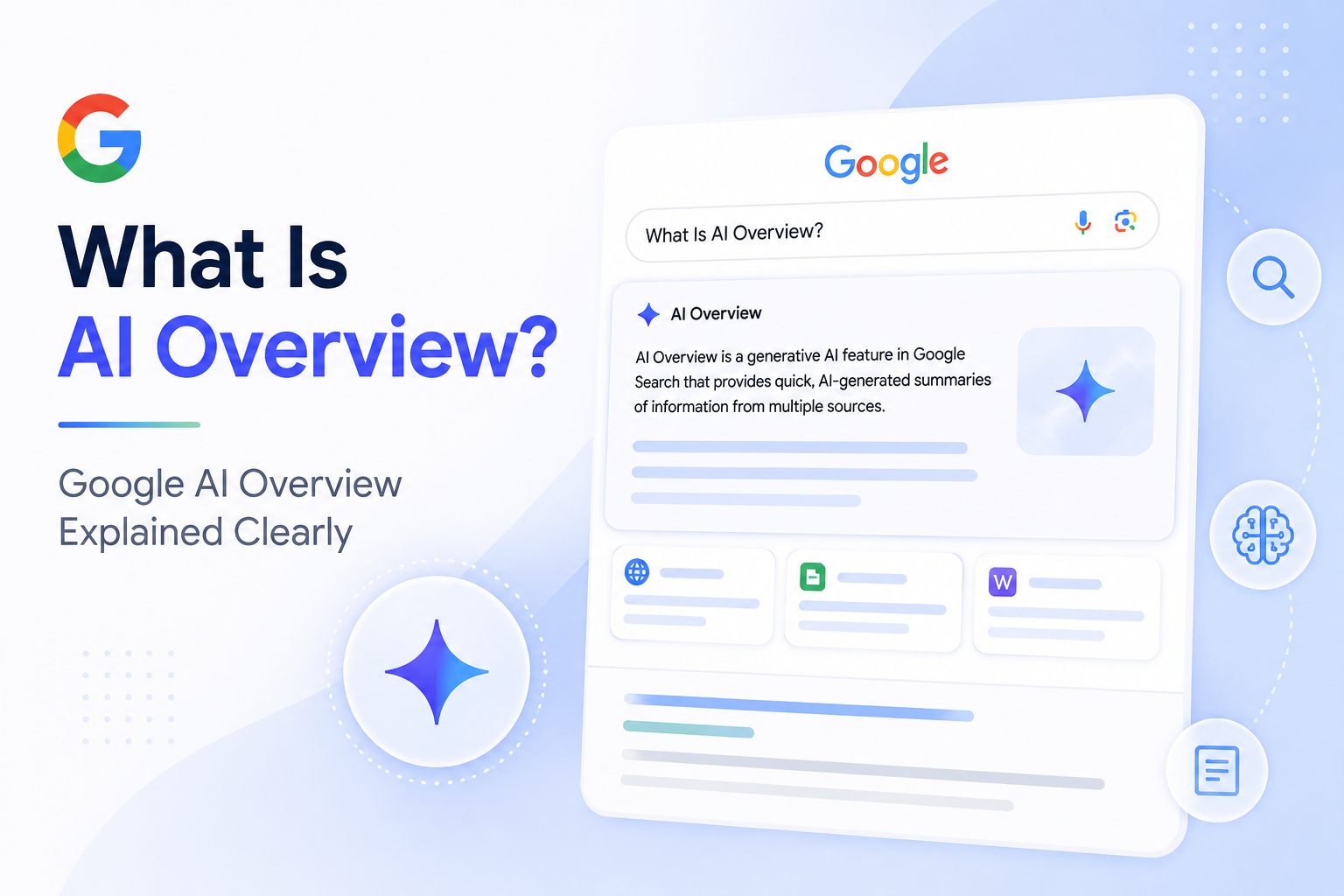
  • What Is AI Overview (Google AI Overview Explained Clearly)

    What Is AI Overview (Google AI Overview Explained Clearly)

    You search for a question on Google Search and get a complete answer before opening a single website. That experience is becoming normal for millions of users.

    Behind this shift is Google AI Overviews, an AI-powered search feature that generates summarized answers directly on the results page. Instead of relying on one source, Google uses generative AI and large language models to combine information from multiple pages across the web.

    AI Overviews are expanding fast. At Google I/O, Google revealed that the feature now reaches more than 1.5 billion users every month. The company also reported a more than 10% increase in search activity for queries where AI Overviews appear, especially in major markets like the U.S. and India.

    This shift is changing how people interact with search results. Users get answers faster, often without clicking through multiple pages. For publishers, brands, and SEO professionals, visibility now depends on more than rankings alone. Content also needs to be clear, trustworthy, and structured well enough to become part of the AI-generated response itself.

    In this guide, you will learn what AI Overview is, how it works, when it appears, and why it matters for SEO, content strategy, and the future of AI-driven search.

    What Is an AI Overview?

    AI Overview is a generative AI-powered feature in Google Search that is powered by Gemini that creates summarized responses for certain search queries, and these summaries appear directly on the search results page (SERP) and are built using information gathered from multiple sources across the web to present a quick and easy-to-understand answer for the user from credible and relevant sources.

    The feature is designed to handle queries that may require explanation, comparison, or synthesized information from different webpages.

    AI Overviews first appeared through Google’s Search Generative Experience (SGE) experiment in Search Labs before expanding into a broader search feature. Today, they are part of Google’s larger shift toward AI-driven search experiences. 

    How Does an AI Overview Work?

    Google AI Overviews work by combining traditional Google Search systems with generative AI models like Gemini to create AI-generated summaries directly in search results. The system understands the search query, retrieves relevant information from multiple web sources, synthesizes the content, and generates an AI-powered response with supporting links and citations.

    When someone searches a complex or informational query, Google’s AI systems work behind the scenes to organize information from across the web into a more readable and contextual answer. Instead of relying on one webpage, AI Overviews analyze multiple sources to help users understand topics faster through a more conversational search experience.

    Here’s a simplified breakdown of how AI Overview works:

    1. Google Understands the Search Query

    The first step is understanding what the user actually means. Google analyzes the intent, context, and complexity behind the search instead of matching only exact keywords.

    For more detailed or multi-part searches, Google uses a process called “query fan-out.” This means the system can break one search into several related searches to gather a broader context before generating a response.

    For example, if someone searches:

    “What is the best time to visit Japan, and how much does a 7-day trip cost?”

    Google may analyze several connected topics at the same time, including:

    • seasonal weather
    • cherry blossom and autumn travel periods
    • flight and hotel pricing
    • transportation costs
    • budget planning

    The AI Overview then generates a structured response with estimated travel costs, recommended travel seasons, budget tips, and follow-up suggestions based on the user’s intent. Instead of showing disconnected webpages separately, the system combines insights into one organized answer.

    2. Google Retrieves Relevant Sources

    After understanding the query, Google retrieves relevant webpages from its Search index. AI overviews are grounded in search, meaning the AI-generated response is connected to information available across the web rather than created without supporting sources.

    Google’s ranking and retrieval systems help identify content that appears relevant, reliable, and useful for the specific query. This is one reason why high-quality and well-structured content remains important in AI-powered search results.

    3. Gemini Synthesizes the Information

    Once the relevant sources are gathered, Google uses its Gemini AI models and large language models to analyze and combine insights from multiple webpages.

    Instead of copying one article directly, the AI synthesizes information by identifying important explanations, patterns, and supporting details across different sources. This creates a more complete and contextual understanding of the topic.

    This is one of the biggest differences between AI Overviews and traditional featured snippets, which usually pull information from a single webpage.

    4. AI Generates the Overview

    After processing the information, the AI generates a summarized response designed to answer the query clearly and quickly. Depending on the type of search, the overview may include the following:

    • concise explanations
    • comparisons
    • recommendations
    • planning suggestions
    • step-by-step guidance

    The format and depth of the answer can also change depending on the complexity of the query and the type of information needed.

    5. Google Adds Links and Citations

    AI Overviews usually include clickable links to supporting webpages and source references. These citations help users explore topics further, verify details, and access more in-depth information from original publishers.

    This is an important part of how Google AI Overviews work. While generative AI creates the summary, the broader web and trusted sources still play a central role in the search experience.

    Understanding how AI Overview works also helps explain why trustworthy, people-first, and well-structured content remains valuable in modern AI-driven search environments.

    What Does an AI Overview Include?

    Most AI Overviews include an AI-generated summary, supporting source links, citations, follow-up prompts, and visual elements designed to help users explore information more quickly within Google Search. The layout can change depending on the ways of the search query, but the goal is to give users a faster and more organized way to understand information directly in Google Search.

    Here are the main components commonly found in an AI Overview:

    1. AI-Generated Summary

    The main part of an AI Overview is the generated summary itself. This section typically appears at the top of the search results page and provides an easy-to-read answer based on information gathered from multiple sources. Depending on the query, the summary may appear as:

    • short paragraphs
    • bulleted lists
    • comparisons
    • recommendations
    • step-by-step explanations

    Unlike traditional featured snippets, AI Overviews usually combine insights from several webpages instead of displaying information from only one source.

    2. Source Links and Citations

    AI Overviews commonly include clickable links to supporting webpages and citations used to generate the response. These links help users:

    • verify information
    • explore topics further
    • access more detailed explanations from publishers and websites

    This is one reason why authoritative and well-structured content still plays an important role in modern AI search results. 

    3. Expandable “Show More” Section

    Many AI Overviews also include expandable “Show more” sections that allow users to explore additional details without leaving the search results page.

    This allows Google to present quick summaries first while still giving users access to deeper information when needed. The expandable layout also helps reduce clutter on the results page.

    4. Follow-Up Questions and Prompts

    Some AI Overviews include follow-up questions or conversational prompts that guide users toward deeper research.

    For example, after answering a travel-related query, Google may suggest related searches like:

    • best cities to visit
    • budget recommendations
    • transportation tips
    • seasonal travel advice

    This creates a more interactive and guided search experience compared to traditional search results.

    5. Visual Elements and Cards

    Depending on the type of search, AI Overviews may also include the following:

    • images
    • product cards
    • maps
    • business listings
    • travel suggestions

    These visual elements help organize information more clearly and improve the overall browsing experience for users.

    Not every AI overview looks the same. Google dynamically changes the layout based on the query, search intent, and type of information being displayed. Searches related to products, travel, comparisons, or planning tasks may show different layouts and interactive elements to match the user’s intent more effectively.

    Example of AI Overview in Search

    To understand how AI Overviews appear in real search results, let’s look at a practical example. Imagine someone searches:

    “How to start an online business with a low budget”

    Instead of showing only regular organic results, Google Search generates an AI Overview at the top of the SERP with a structured and summarized answer.

    A typical AI Overview for this type of query could include:

    • low-cost business ideas
    • basic startup steps
    • free or affordable tools
    • marketing suggestions
    • estimated setup costs

    The response may also organize the information into sections such as:

    • Choosing a Business Idea
    • Creating a Website
    • Marketing on a Budget
    • Free Tools for Beginners

    Alongside the AI-generated summary, Google often displays:

    • supporting website links
    • source citations
    • expandable “Show more” explanations
    • related follow-up questions

    For example, users may see additional prompts like:

    • best online businesses for beginners
    • how much money is needed to start
    • free tools for small businesses
    • how to market an online business

    This helps users gather organized information faster instead of opening multiple webpages individually to research the same topic.

    Depending on the query, AI Overviews also include visual elements like product cards, images, maps, or business listings to improve the overall AI-powered search experience.

    AI Overviews are changing Google Search from a link-first experience toward a more organized answer-first experience for many informational queries. At the same time, users can still explore source links and webpages for deeper research and additional context.

    When Does an AI Overview Appear?

    Google AI Overviews typically appear when Google Search believes an AI-generated response can help users understand a topic faster or more clearly than traditional search results alone. They commonly show up for complex, conversational, or multi-part queries that require information from multiple sources.

    AI Overviews do not appear for every search. Google dynamically decides when generative AI can provide additional value based on the search intent, query complexity, and type of information being requested.

    Here are some of the most common situations where AI Overviews may appear:

    1. Complex Informational Searches

    AI Overviews often appear for informational queries that require deeper explanations or broader context.

    For example:

    • how does AI Overview work
    • what is cloud computing
    • how does intermittent fasting affect the body

    These searches usually involve concepts that benefit from summarized explanations gathered from multiple sources.

    2. Comparisons and Recommendations

    Google may also show AI Overviews for searches involving comparisons, recommendations, or decision-making.

    Examples include:

    • best laptop for video editing
    • iPhone vs Samsung for photography
    • best protein sources for muscle gain

    In these cases, AI-generated answers can help organize different options, pros and cons, and recommendations into a more structured response.

    3. Planning and Research Queries

    AI Overviews commonly appear for planning-related searches where users need organized information quickly.

    For example:

    • how to start an online business
    • best time to visit Japan
    • how to prepare for a marathon

    These queries often involve multiple steps, budgeting, recommendations, timelines, or research-based guidance.

    4. Conversational or Multi-Part Searches

    One of the biggest shifts in AI-powered search is the rise of conversational queries. Instead of typing short keywords, users increasingly search using natural language questions.

    Examples include:

    • What is the best way to learn SEO as a beginner?
    • How much does it cost to start a podcast, and what equipment is needed?
    • Which programming language should I learn first for AI development?

    These searches are more nuanced and context-driven, which makes them well-suited for AI-generated summaries and synthesized answers.

    AI Overviews are designed to appear when Google believes users would benefit from a faster, more organized, and contextual answer. However, the feature is dynamic, so the same query may not always generate an AI Overview for every user, location, or search situation.

    AI Overview vs Featured Snippet

    Google AI Overviews and featured snippets both appear prominently in Google Search results, but they function very differently. Featured snippets usually pull information from a single webpage, while AI Overviews use generative AI to combine insights from multiple sources into a more contextual and interactive response.

    In simple terms:

    Featured snippets extract information. AI Overviews synthesize information.

    Here’s a clearer comparison between the two:

    AI Overview

    • Combines information from multiple webpages
    • Generates AI-created summaries using large language models
    • Best suited for complex, conversational, or multi-part queries
    • Often includes follow-up prompts and contextual suggestions
    • Uses dynamic layouts that may include images, product cards, or expandable sections

    Featured Snippet

    • Usually pulls content from a single webpage
    • Displays direct extracted answers
    • Commonly appears for simple informational searches
    • Typically uses a more fixed and static format
    • Often shows paragraphs, lists, or tables from one source

    For example, a featured snippet may directly answer:

    “How many ounces are in a cup?”

    using a short paragraph or list from a single webpage.

    An AI Overview, however, combines explanations, comparisons, examples, and supporting links from several sources to create a broader and more organized response.

    Another major difference is flexibility. AI Overviews can adapt their format depending on the search query and may include:

    • source citations
    • follow-up questions
    • images or product cards
    • expandable explanations

    Featured snippets are generally more limited in structure and focus mainly on delivering quick, direct answers.

    While AI Overviews are pushing Google Search toward more synthesized and context-aware search experiences, featured snippets still remain an important part of traditional search results and continue appearing for many direct-answer queries.

    Why AI Overview Matters

    Google AI Overviews matter because they are changing how people discover, consume, and interact with information in Google Search. Instead of only showing a list of webpages, Google can now provide faster, more contextual, and AI-generated answers directly on the search results page.

    This shift is happening at a massive scale. Google officially reported that AI Overviews are now reaching more than 2 billion monthly users globally.

    The company also stated that AI Overviews are driving over 10% growth in Google usage for the types of queries where they appear in major markets like the U.S. and India.

    This growing adoption is changing the overall search experience for users, especially for informational, conversational, and research-focused queries.

    Here are some of the biggest reasons AI Overviews matter:

    1. Faster Access to Information

    AI Overviews help users understand topics more quickly by summarizing information from multiple sources into one organized response.

    Instead of opening several webpages separately, users can often get:

    • quick explanations
    • comparisons
    • recommendations
    • planning guidance
    • key takeaways

    directly from the search results page.

    2. More Contextual and Organized Answers

    Traditional search results usually require users to gather and compare information manually from different websites.

    AI Overviews change this by organizing information into more structured and context-driven summaries. This can make complex topics easier to understand, especially for multi-part or nuanced searches.

    3. Reduced Search Friction

    One of the biggest goals of AI-powered search is reducing the effort required to find useful information.

    For example, instead of searching multiple times for:

    • recommendations
    • definitions
    • comparisons
    • pricing details

    Users may receive a broader and more complete answer within a single AI Overview.

    4. Shift Toward Conversational Search

    Search behavior is also evolving. Users are now more commonly searching with natural language and conversational queries instead of short keyword-based searches.

    For example:

    “What is the best way to learn SEO as a beginner?”

    Instead of simply searching:

    “SEO guide”

    AI Overviews are designed to handle these more conversational and context-rich searches more effectively.

    5. Growing Influence on Information Discovery

    AI Overviews are becoming an important part of how users discover information online. Instead of functioning only as a search engine that points users toward webpages, Google is gradually evolving into a system that helps organize and explain information directly within search results.

    This represents a major shift toward more AI-powered and answer-first search experiences.

    As AI Overviews continue expanding across Google Search, they are likely to influence not only how users search for information but also how websites, publishers, and businesses think about visibility in modern search environments.

    How AI Overview Is Changing User Behavior

    Google AI Overviews are changing how users interact with search results and consume information online. Instead of opening multiple webpages to compare answers manually, many users now expect faster, more organized, and conversational responses directly within Google Search.

    One of the biggest behavioral shifts is the growing preference for quick-answer experiences. Users increasingly rely on AI-generated summaries to understand topics, compare options, and gather key information without navigating through several websites separately.

    Search behavior is also becoming more conversational. Rather than typing short keyword phrases, users now search using:

    • complete questions
    • follow-up prompts
    • planning-based searches
    • comparison-style queries

    For example, instead of searching:

    “best running shoes”

    Many users now search:

    “What are the best running shoes for beginners with flat feet?”

    AI Overviews are designed to handle these more natural and context-rich queries by generating structured and synthesized responses.

    Another major shift is how users explore information. AI Overviews often encourage deeper interaction through:

    • follow-up questions
    • related search prompts
    • recommendations
    • contextual suggestions

    This creates a more guided and interactive search experience compared to traditional link-first search behavior.

    As AI-assisted search continues evolving, users are gradually expecting search engines to provide:

    • faster answers
    • summarized insights
    • contextual explanations
    • more personalized discovery experiences

    This behavioral shift is influencing not only how people search for information, but also how websites, publishers, and businesses think about visibility in modern search environments.

    How AI Overview Affects SEO

    Google AI Overviews are changing how users interact with Google Search results, especially for informational and research-focused queries. Because AI-generated summaries can answer questions directly on the search results page, many websites are seeing shifts in clicks, organic traffic, visibility, and user behavior.

    This does not mean SEO is disappearing, but it does mean search visibility is evolving as Google moves toward more answer-first and AI-driven search experiences.

    Here are some of the biggest ways AI Overviews are affecting SEO:

    1. Rise of Zero-Click Searches

    One of the most discussed impacts of AI Overviews is the growth of zero-click searches. Instead of visiting multiple websites, users can now often get:

    • summaries
    • recommendations
    • comparisons
    • quick explanations

    directly from the search interface.

    This can reduce clicks for certain informational searches, especially when users find enough information inside the AI-generated response itself.

    2. Changes in Click-Through Rates (CTR)

    AI Overviews also affect click-through rates for traditional organic listings.

    Industry studies have already reported noticeable CTR shifts when AI Overviews appear in search results. Seer Interactive found that organic CTR for queries with AI Overviews dropped from 1.41% to 0.64%, while Ahrefs reported a 34.5% decline in clicks to top-ranking informational content in some cases.

    User behavior research also suggests that AI-generated summaries are changing how people interact with search results. Some studies found that users clicked traditional search result links in only 8% of visits when an AI Overview appeared, compared with 15% for searches without AI-generated summaries. This reflects how answer-first search experiences can reduce the need for users to open multiple webpages for informational queries.

    When an AI-generated summary appears above regular organic results, users may spend more time interacting with the overview before deciding whether to visit a webpage.

    However, websites featured within AI Overview citations may still gain visibility, authority, and higher-intent traffic from users looking for deeper information.

    3. Greater Importance of Authority and Trust

    As AI-driven search becomes more prominent, trustworthy and well-structured content is becoming more important than ever. Google’s systems are designed to prioritize content that demonstrates the following:

    • expertise
    • clarity
    • topical relevance
    • reliability

    This shift is encouraging SEO strategies that focus more on topical authority, semantic relevance, and people-first content rather than relying only on traditional keyword targeting.

    4. Increased Competition for Visibility

    AI Overviews create a new visibility layer within search results. Instead of competing only for traditional organic rankings, websites now also compete for visibility inside:

    • AI-generated summaries
    • source citations
    • recommendation sections
    • follow-up search experiences

    This makes structured, high-quality, and context-rich content more important in modern SEO environments.

    5. Shift Toward Answer-First Search

    Google Search is gradually evolving from a link-first discovery system toward a more answer-first experience for many informational queries.

    Search behavior now favors:

    • faster answers
    • organized information
    • conversational responses
    • contextual guidance

    directly within the SERP.

    As a result, the goal of SEO is slowly shifting from simply ranking number one toward becoming a trusted source that AI systems choose to reference and cite.

    The impact of AI Overviews is often strongest for informational searches, where users can get answers directly from AI-generated summaries. However, not all query types are affected equally, especially transactional or branded searches, where users still rely heavily on traditional website visits.

    AI Overviews are clearly reshaping modern SEO, but they are not replacing the need for websites or quality content. Google officially states that AI Overviews still include links to webpages and continue helping users discover content across the web. Instead, the larger shift is happening in how information is surfaced, consumed, and discovered within evolving AI-powered search environments.

    Can You Optimize for AI Overview?

    Yes, you can optimize content for Google AI Overviews by creating clear, well-structured, and people-first content that directly answers user queries. The most effective strategies typically include improving topical authority, using organized formatting, targeting conversational searches, and demonstrating strong E-E-A-T (experience, expertise, authoritativeness, and trustworthiness).

    Unlike traditional SEO tactics focused heavily on keywords alone, AI Overview optimization is more focused on helping search systems clearly understand, summarize, and trust your content within evolving AI-driven search experiences. 

    Here are some of the most important ways to optimize for AI Overviews:

    1. Create People-First Content

    Google consistently emphasizes creating content that is genuinely useful for users instead of content written only for search engines.

    Content that demonstrates:

    • expertise
    • originality
    • trustworthiness
    • practical value

    is more likely to perform well in AI-driven search experiences.

    2. Answer Questions Clearly and Directly

    Search systems often favor content that provides concise and well-structured answers to specific questions.

    For example, using:

    • clear headings
    • direct explanations
    • bullet points
    • short summaries

    can make information easier to scan, understand, and extract. This is especially important for conversational and long-tail search queries.

    3. Build Topical Authority

    AI Overviews commonly pull information from sources that show strong topical relevance and depth.

    Instead of creating isolated articles targeting only individual keywords, many SEO strategies now focus on building comprehensive topic coverage around a subject.

    For example, a website covering:

    • SEO basics
    • keyword research
    • technical SEO
    • AI search optimization
    • content strategy

    may build stronger topical authority than a site publishing unrelated standalone posts.

    4. Use Structured and Organized Content

    Well-structured content is easier for both users and generative search models to process.

    Helpful formatting elements include:

    • descriptive headings
    • logical section hierarchy
    • lists and tables
    • concise paragraphs
    • contextual examples

    This improves readability while also helping search technologies understand relationships between topics and entities more clearly.

    5. Focus on Trust, Accuracy, and E-E-A-T

    Google continues emphasizing E-E-A-T principles:

    • Experience
    • Expertise
    • Authoritativeness
    • Trustworthiness

    This becomes even more important in AI-generated search environments where systems attempt to surface reliable and high-confidence information.

    Accurate facts, credible sourcing, updated information, and real expertise all contribute to stronger trust signals.

    6. Optimize for Conversational and Long-Tail Queries

    Search behavior is becoming more conversational, especially with AI-generated search experiences. Instead of targeting only short keywords, many websites now optimize for:

    • natural-language questions
    • comparison searches
    • planning queries
    • problem-solving intent

    This aligns more closely with how users interact with AI-powered search systems.

    There is no special “AI Overview trick” that guarantees visibility. In many ways, AI Overviews are reinforcing the importance of strong SEO fundamentals rather than replacing them. Visibility can also vary depending on the query, search intent, location, and the type of information being requested.

    Websites that create clear, trustworthy, well-structured, and semantically rich content are generally better positioned for evolving AI-driven search environments.

    Limitations of AI Overviews

    Google AI Overviews can help users access information faster, but like all generative AI systems, they still have important limitations. AI-powered summaries may sometimes contain inaccurate, incomplete, oversimplified, or inconsistent information, especially for complex or rapidly changing topics.

    While Google Search continues improving AI-driven search experiences, important information should still be verified using reliable and authoritative sources.

    Here are some of the main limitations of AI Overviews:

    1. Inaccurate or Fabricated Information

    One of the biggest concerns with AI-powered summaries is the risk of inaccuracies or “hallucinations.” In some situations, generative systems may:

    • generate incorrect facts
    • misinterpret information
    • combine details inaccurately
    • present misleading answers confidently

    This can sometimes contribute to misinformation, especially when users rely entirely on summarized answers without checking the original sources.

    2. Missing Context and Oversimplification

    AI Overviews are designed to provide quick and concise summaries, but this can sometimes reduce important context or nuance. For example, topics related to:

    • health
    • law
    • finance
    • technical subjects

    may require deeper explanation, expert interpretation, or situational context that short summaries cannot fully capture. As a result, users may receive simplified answers that do not reflect the full complexity of a topic.

    3. Dynamic and Inconsistent Results

    AI Overviews are highly dynamic and can change frequently. The same search query may produce different AI-generated responses depending on factors such as:

    • search updates
    • user location
    • query wording
    • available sources
    • system changes over time

    This can sometimes make results feel inconsistent or difficult to reproduce exactly.

    4. Risk of Over-Relying on AI Summaries

    Because AI Overviews appear prominently at the top of search results, some users may rely on them without reviewing the original sources.

    This can reduce:

    • deeper research
    • source verification
    • critical evaluation of information

    For important decisions, especially involving health, legal, or financial matters, expert guidance and trusted sources remain essential.

    5. Impact on Publishers and Website Traffic

    AI Overviews have also raised concerns among publishers and website owners. Since users can sometimes get answers directly on the search results page, some websites may experience the following:

    • Lower click-through rates
    • Reduced organic traffic
    • Less visibility for informational content

    At the same time, websites featured as trusted citations inside AI Overviews may still benefit from brand exposure and higher-intent visitors.

    AI Overviews are still evolving, and Google continues refining the system to improve accuracy, reliability, and source quality. While the feature can make search faster and more convenient, using multiple reliable sources remains important when researching critical or high-impact topics.

    Future of AI Search and AI Overviews

    The future of AI search is moving beyond simple information retrieval toward more conversational, contextual, and AI-assisted experiences. Google AI Overviews are part of a broader shift where search engines increasingly aim to help users understand, organize, and interact with information instead of only displaying lists of webpages.

    As Google Search continues evolving, AI-driven search experiences are expected to become more interactive, personalized, and deeply integrated into how people discover information online.

    Here are some of the biggest trends shaping the future of AI search and AI Overviews:

    1. Growth of Conversational Search

    Search behavior is becoming more conversational and natural-language driven. Instead of typing short keyword phrases, users now more frequently ask:

    • complete questions
    • follow-up queries
    • comparison-based searches
    • planning and research prompts

    Google is continuing to expand AI-generated search experiences that support deeper interactions and more context-aware responses.

    2. Expansion of AI Mode and Advanced Reasoning

    Google has already introduced AI Mode to support more advanced search interactions, including:

    • deeper reasoning
    • follow-up exploration
    • multi-step research
    • complex query handling

    This signals a broader movement toward search experiences that behave more like intelligent assistants instead of traditional search engines.

    3. Growth of Multimodal Search

    The future of search is evolving into a more multimodal experience. AI-assisted search systems are expanding beyond text alone to support the following:

    • voice search
    • image search
    • video understanding
    • visual search experiences
    • camera-based search interactions

    This allows users to search using different types of inputs and receive richer, more contextual responses.

    4. Greater Focus on Trusted and Original Content

    As AI-generated summaries become more common, trusted and original content will likely become even more important.

    Google continues emphasizing:

    • authoritative information
    • firsthand expertise
    • high-quality sources
    • reliable content signals

    This means websites offering unique insights, expert knowledge, and authentic experiences may become more valuable in generative search environments.

    5. Search Visibility Evolving Beyond Traditional Clicks

    AI Overviews are already changing how visibility works in search. Instead of measuring success only through traditional rankings and clicks, future search environments may place greater importance on:

    • citations in AI summaries
    • brand visibility
    • topical authority
    • trusted mentions
    • contextual relevance

    This highlights a broader shift toward answer-first and AI-assisted discovery experiences.

    Google has also stated that it continues improving AI Overviews through ranking systems, safety systems, and user feedback to improve accuracy and reliability over time.

    At the same time, traditional webpages and publishers are still expected to remain an essential part of the search ecosystem. AI search is still evolving rapidly, but one thing is becoming increasingly clear: AI Overviews are likely only one part of the broader future of search, where AI-assisted systems increasingly shape how people discover, understand, and interact with information online.

    Conclusion

    Google AI Overviews are transforming how people search, discover, and interact with information online. By combining generative AI with traditional search results, Google Search now delivers faster, more conversational, and context-aware answers directly within the search experience. From query fan-out and AI-generated summaries to multimodal and conversational search, AI Overviews represent a major shift in how modern search engines understand and present information.

    As AI-powered search continues changing, understanding Google AI Overviews is becoming essential for users, businesses, publishers, and SEO professionals. At the same time, AI-generated summaries still have limitations, which makes trusted sources, expert-created content, and fact verification more important than ever.

    Looking ahead, AI Overviews are likely only the beginning of a broader transition toward more intelligent and AI-assisted search systems. Websites that focus on people-first content, topical authority, semantic clarity, and genuine expertise will remain better positioned for long-term visibility in the evolving search ecosystem.

    FAQs

    How Do You Use Google AI Overview?

    You can use Google AI Overviews by searching normally in Google Search. When available, the AI Overview appears at the top of results with AI-generated summaries, source links, follow-up questions, and quick insights to help users explore topics, compare information, and find answers faster. For important topics, it’s still best to review the original sources and verify key details.

    Is AI Overview Trustworthy?

    Google AI Overviews are generally useful for quick summaries and informational searches, but they are not always fully accurate. Like other generative AI systems, AI Overviews can sometimes produce incomplete, misleading, or incorrect answers, so important information should still be verified using reliable and authoritative sources.

    Can I Turn Off AI Overview?

    Google currently does not offer a permanent way to fully disable AI Overviews in regular Google Search results. However, some users can reduce or bypass them using the “Web” filter, Search Labs settings (where available), or browser extensions that hide AI-generated sections and show more traditional link-based results.

    Is AI Overview the Same as ChatGPT?

    No, Google AI Overview and ChatGPT are not the same. While both use generative AI to answer questions, AI Overview is a search-integrated feature inside Google Search that summarizes web information, whereas ChatGPT is a conversational AI platform designed for interactive discussions, problem-solving, and content generation.

    Why Does Google Show AI Overviews?

    Google shows AI Overviews to help users find and understand information faster by summarizing insights from multiple web sources into a single AI-generated response. Powered by Gemini models, AI Overviews are designed to improve Google Search experiences, especially for complex, conversational, comparison-based, and “how-to” queries.

    How Do I Keep AI Overviews Enabled in Google Search?

    To keep AI Overviews enabled in Google Search, sign into your Google account, use a supported language and region, and keep “AI Overviews and more” enabled in Search Labs where available. AI-generated summaries are more likely to appear when using updated browsers and standard Google Search results instead of the “Web” filter.