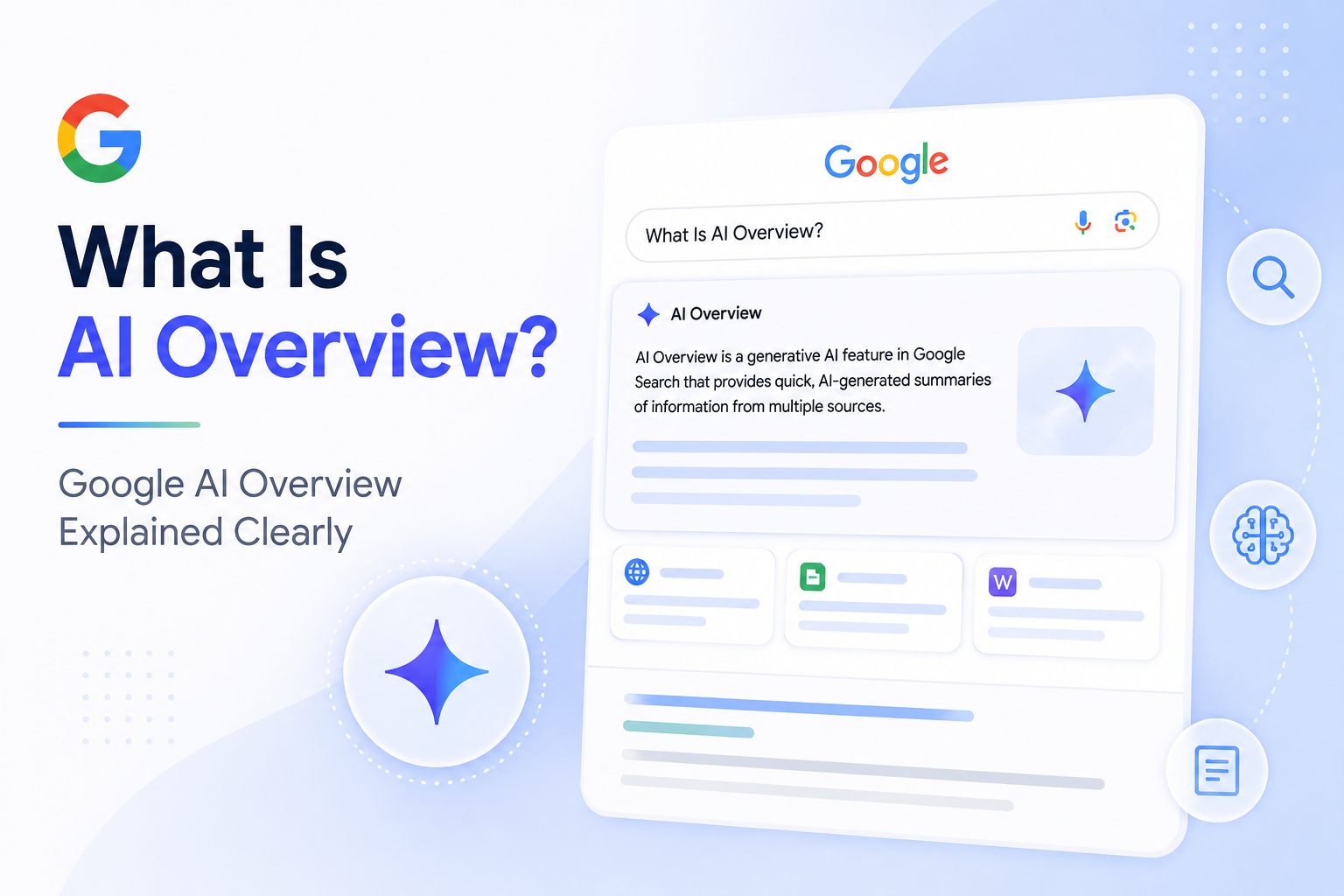
You search for a question on Google Search and get a complete answer before opening a single website. That experience is becoming normal for millions of users.
Behind this shift is Google AI Overviews, an AI-powered search feature that generates summarized answers directly on the results page. Instead of relying on one source, Google uses generative AI and large language models to combine information from multiple pages across the web.
AI Overviews are expanding fast. At Google I/O, Google revealed that the feature now reaches more than 1.5 billion users every month. The company also reported a more than 10% increase in search activity for queries where AI Overviews appear, especially in major markets like the U.S. and India.
This shift is changing how people interact with search results. Users get answers faster, often without clicking through multiple pages. For publishers, brands, and SEO professionals, visibility now depends on more than rankings alone. Content also needs to be clear, trustworthy, and structured well enough to become part of the AI-generated response itself.
In this guide, you will learn what AI Overview is, how it works, when it appears, and why it matters for SEO, content strategy, and the future of AI-driven search.
What Is an AI Overview?
AI Overview is a generative AI-powered feature in Google Search that is powered by Gemini that creates summarized responses for certain search queries, and these summaries appear directly on the search results page (SERP) and are built using information gathered from multiple sources across the web to present a quick and easy-to-understand answer for the user from credible and relevant sources.
The feature is designed to handle queries that may require explanation, comparison, or synthesized information from different webpages.
AI Overviews first appeared through Google’s Search Generative Experience (SGE) experiment in Search Labs before expanding into a broader search feature. Today, they are part of Google’s larger shift toward AI-driven search experiences.
How Does an AI Overview Work?

Google AI Overviews work by combining traditional Google Search systems with generative AI models like Gemini to create AI-generated summaries directly in search results. The system understands the search query, retrieves relevant information from multiple web sources, synthesizes the content, and generates an AI-powered response with supporting links and citations.
When someone searches a complex or informational query, Google’s AI systems work behind the scenes to organize information from across the web into a more readable and contextual answer. Instead of relying on one webpage, AI Overviews analyze multiple sources to help users understand topics faster through a more conversational search experience.
Here’s a simplified breakdown of how AI Overview works:
1. Google Understands the Search Query
The first step is understanding what the user actually means. Google analyzes the intent, context, and complexity behind the search instead of matching only exact keywords.
For more detailed or multi-part searches, Google uses a process called “query fan-out.” This means the system can break one search into several related searches to gather a broader context before generating a response.
For example, if someone searches:
“What is the best time to visit Japan, and how much does a 7-day trip cost?”
Google may analyze several connected topics at the same time, including:
- seasonal weather
- cherry blossom and autumn travel periods
- flight and hotel pricing
- transportation costs
- budget planning
The AI Overview then generates a structured response with estimated travel costs, recommended travel seasons, budget tips, and follow-up suggestions based on the user’s intent. Instead of showing disconnected webpages separately, the system combines insights into one organized answer.
2. Google Retrieves Relevant Sources
After understanding the query, Google retrieves relevant webpages from its Search index. AI overviews are grounded in search, meaning the AI-generated response is connected to information available across the web rather than created without supporting sources.
Google’s ranking and retrieval systems help identify content that appears relevant, reliable, and useful for the specific query. This is one reason why high-quality and well-structured content remains important in AI-powered search results.
3. Gemini Synthesizes the Information
Once the relevant sources are gathered, Google uses its Gemini AI models and large language models to analyze and combine insights from multiple webpages.
Instead of copying one article directly, the AI synthesizes information by identifying important explanations, patterns, and supporting details across different sources. This creates a more complete and contextual understanding of the topic.
This is one of the biggest differences between AI Overviews and traditional featured snippets, which usually pull information from a single webpage.
4. AI Generates the Overview
After processing the information, the AI generates a summarized response designed to answer the query clearly and quickly. Depending on the type of search, the overview may include the following:
- concise explanations
- comparisons
- recommendations
- planning suggestions
- step-by-step guidance
The format and depth of the answer can also change depending on the complexity of the query and the type of information needed.
5. Google Adds Links and Citations
AI Overviews usually include clickable links to supporting webpages and source references. These citations help users explore topics further, verify details, and access more in-depth information from original publishers.
This is an important part of how Google AI Overviews work. While generative AI creates the summary, the broader web and trusted sources still play a central role in the search experience.
Understanding how AI Overview works also helps explain why trustworthy, people-first, and well-structured content remains valuable in modern AI-driven search environments.
What Does an AI Overview Include?
Most AI Overviews include an AI-generated summary, supporting source links, citations, follow-up prompts, and visual elements designed to help users explore information more quickly within Google Search. The layout can change depending on the ways of the search query, but the goal is to give users a faster and more organized way to understand information directly in Google Search.
Here are the main components commonly found in an AI Overview:
1. AI-Generated Summary
The main part of an AI Overview is the generated summary itself. This section typically appears at the top of the search results page and provides an easy-to-read answer based on information gathered from multiple sources. Depending on the query, the summary may appear as:
- short paragraphs
- bulleted lists
- comparisons
- recommendations
- step-by-step explanations
Unlike traditional featured snippets, AI Overviews usually combine insights from several webpages instead of displaying information from only one source.
2. Source Links and Citations
AI Overviews commonly include clickable links to supporting webpages and citations used to generate the response. These links help users:
- verify information
- explore topics further
- access more detailed explanations from publishers and websites
This is one reason why authoritative and well-structured content still plays an important role in modern AI search results.
3. Expandable “Show More” Section
Many AI Overviews also include expandable “Show more” sections that allow users to explore additional details without leaving the search results page.
This allows Google to present quick summaries first while still giving users access to deeper information when needed. The expandable layout also helps reduce clutter on the results page.
4. Follow-Up Questions and Prompts
Some AI Overviews include follow-up questions or conversational prompts that guide users toward deeper research.
For example, after answering a travel-related query, Google may suggest related searches like:
- best cities to visit
- budget recommendations
- transportation tips
- seasonal travel advice
This creates a more interactive and guided search experience compared to traditional search results.
5. Visual Elements and Cards
Depending on the type of search, AI Overviews may also include the following:
- images
- product cards
- maps
- business listings
- travel suggestions
These visual elements help organize information more clearly and improve the overall browsing experience for users.
Not every AI overview looks the same. Google dynamically changes the layout based on the query, search intent, and type of information being displayed. Searches related to products, travel, comparisons, or planning tasks may show different layouts and interactive elements to match the user’s intent more effectively.
Example of AI Overview in Search
To understand how AI Overviews appear in real search results, let’s look at a practical example. Imagine someone searches:
“How to start an online business with a low budget”
Instead of showing only regular organic results, Google Search generates an AI Overview at the top of the SERP with a structured and summarized answer.
A typical AI Overview for this type of query could include:
- low-cost business ideas
- basic startup steps
- free or affordable tools
- marketing suggestions
- estimated setup costs
The response may also organize the information into sections such as:
- Choosing a Business Idea
- Creating a Website
- Marketing on a Budget
- Free Tools for Beginners
Alongside the AI-generated summary, Google often displays:
- supporting website links
- source citations
- expandable “Show more” explanations
- related follow-up questions
For example, users may see additional prompts like:
- best online businesses for beginners
- how much money is needed to start
- free tools for small businesses
- how to market an online business
This helps users gather organized information faster instead of opening multiple webpages individually to research the same topic.
Depending on the query, AI Overviews also include visual elements like product cards, images, maps, or business listings to improve the overall AI-powered search experience.
AI Overviews are changing Google Search from a link-first experience toward a more organized answer-first experience for many informational queries. At the same time, users can still explore source links and webpages for deeper research and additional context.
When Does an AI Overview Appear?
Google AI Overviews typically appear when Google Search believes an AI-generated response can help users understand a topic faster or more clearly than traditional search results alone. They commonly show up for complex, conversational, or multi-part queries that require information from multiple sources.
AI Overviews do not appear for every search. Google dynamically decides when generative AI can provide additional value based on the search intent, query complexity, and type of information being requested.
Here are some of the most common situations where AI Overviews may appear:
1. Complex Informational Searches
AI Overviews often appear for informational queries that require deeper explanations or broader context.
For example:
- how does AI Overview work
- what is cloud computing
- how does intermittent fasting affect the body
These searches usually involve concepts that benefit from summarized explanations gathered from multiple sources.
2. Comparisons and Recommendations
Google may also show AI Overviews for searches involving comparisons, recommendations, or decision-making.
Examples include:
- best laptop for video editing
- iPhone vs Samsung for photography
- best protein sources for muscle gain
In these cases, AI-generated answers can help organize different options, pros and cons, and recommendations into a more structured response.
3. Planning and Research Queries
AI Overviews commonly appear for planning-related searches where users need organized information quickly.
For example:
- how to start an online business
- best time to visit Japan
- how to prepare for a marathon
These queries often involve multiple steps, budgeting, recommendations, timelines, or research-based guidance.
4. Conversational or Multi-Part Searches
One of the biggest shifts in AI-powered search is the rise of conversational queries. Instead of typing short keywords, users increasingly search using natural language questions.
Examples include:
- What is the best way to learn SEO as a beginner?
- How much does it cost to start a podcast, and what equipment is needed?
- Which programming language should I learn first for AI development?
These searches are more nuanced and context-driven, which makes them well-suited for AI-generated summaries and synthesized answers.
AI Overviews are designed to appear when Google believes users would benefit from a faster, more organized, and contextual answer. However, the feature is dynamic, so the same query may not always generate an AI Overview for every user, location, or search situation.
AI Overview vs Featured Snippet

Google AI Overviews and featured snippets both appear prominently in Google Search results, but they function very differently. Featured snippets usually pull information from a single webpage, while AI Overviews use generative AI to combine insights from multiple sources into a more contextual and interactive response.
In simple terms:
Featured snippets extract information. AI Overviews synthesize information.
Here’s a clearer comparison between the two:
AI Overview
- Combines information from multiple webpages
- Generates AI-created summaries using large language models
- Best suited for complex, conversational, or multi-part queries
- Often includes follow-up prompts and contextual suggestions
- Uses dynamic layouts that may include images, product cards, or expandable sections
Featured Snippet
- Usually pulls content from a single webpage
- Displays direct extracted answers
- Commonly appears for simple informational searches
- Typically uses a more fixed and static format
- Often shows paragraphs, lists, or tables from one source
For example, a featured snippet may directly answer:
“How many ounces are in a cup?”
using a short paragraph or list from a single webpage.
An AI Overview, however, combines explanations, comparisons, examples, and supporting links from several sources to create a broader and more organized response.
Another major difference is flexibility. AI Overviews can adapt their format depending on the search query and may include:
- source citations
- follow-up questions
- images or product cards
- expandable explanations
Featured snippets are generally more limited in structure and focus mainly on delivering quick, direct answers.
While AI Overviews are pushing Google Search toward more synthesized and context-aware search experiences, featured snippets still remain an important part of traditional search results and continue appearing for many direct-answer queries.
Why AI Overview Matters
Google AI Overviews matter because they are changing how people discover, consume, and interact with information in Google Search. Instead of only showing a list of webpages, Google can now provide faster, more contextual, and AI-generated answers directly on the search results page.
This shift is happening at a massive scale. Google officially reported that AI Overviews are now reaching more than 2 billion monthly users globally.
The company also stated that AI Overviews are driving over 10% growth in Google usage for the types of queries where they appear in major markets like the U.S. and India.
This growing adoption is changing the overall search experience for users, especially for informational, conversational, and research-focused queries.
Here are some of the biggest reasons AI Overviews matter:
1. Faster Access to Information
AI Overviews help users understand topics more quickly by summarizing information from multiple sources into one organized response.
Instead of opening several webpages separately, users can often get:
- quick explanations
- comparisons
- recommendations
- planning guidance
- key takeaways
directly from the search results page.
2. More Contextual and Organized Answers
Traditional search results usually require users to gather and compare information manually from different websites.
AI Overviews change this by organizing information into more structured and context-driven summaries. This can make complex topics easier to understand, especially for multi-part or nuanced searches.
3. Reduced Search Friction
One of the biggest goals of AI-powered search is reducing the effort required to find useful information.
For example, instead of searching multiple times for:
- recommendations
- definitions
- comparisons
- pricing details
Users may receive a broader and more complete answer within a single AI Overview.
4. Shift Toward Conversational Search
Search behavior is also evolving. Users are now more commonly searching with natural language and conversational queries instead of short keyword-based searches.
For example:
“What is the best way to learn SEO as a beginner?”
Instead of simply searching:
“SEO guide”
AI Overviews are designed to handle these more conversational and context-rich searches more effectively.
5. Growing Influence on Information Discovery
AI Overviews are becoming an important part of how users discover information online. Instead of functioning only as a search engine that points users toward webpages, Google is gradually evolving into a system that helps organize and explain information directly within search results.
This represents a major shift toward more AI-powered and answer-first search experiences.
As AI Overviews continue expanding across Google Search, they are likely to influence not only how users search for information but also how websites, publishers, and businesses think about visibility in modern search environments.
How AI Overview Is Changing User Behavior

Google AI Overviews are changing how users interact with search results and consume information online. Instead of opening multiple webpages to compare answers manually, many users now expect faster, more organized, and conversational responses directly within Google Search.
One of the biggest behavioral shifts is the growing preference for quick-answer experiences. Users increasingly rely on AI-generated summaries to understand topics, compare options, and gather key information without navigating through several websites separately.
Search behavior is also becoming more conversational. Rather than typing short keyword phrases, users now search using:
- complete questions
- follow-up prompts
- planning-based searches
- comparison-style queries
For example, instead of searching:
“best running shoes”
Many users now search:
“What are the best running shoes for beginners with flat feet?”
AI Overviews are designed to handle these more natural and context-rich queries by generating structured and synthesized responses.
Another major shift is how users explore information. AI Overviews often encourage deeper interaction through:
- follow-up questions
- related search prompts
- recommendations
- contextual suggestions
This creates a more guided and interactive search experience compared to traditional link-first search behavior.
As AI-assisted search continues evolving, users are gradually expecting search engines to provide:
- faster answers
- summarized insights
- contextual explanations
- more personalized discovery experiences
This behavioral shift is influencing not only how people search for information, but also how websites, publishers, and businesses think about visibility in modern search environments.
How AI Overview Affects SEO
Google AI Overviews are changing how users interact with Google Search results, especially for informational and research-focused queries. Because AI-generated summaries can answer questions directly on the search results page, many websites are seeing shifts in clicks, organic traffic, visibility, and user behavior.
This does not mean SEO is disappearing, but it does mean search visibility is evolving as Google moves toward more answer-first and AI-driven search experiences.
Here are some of the biggest ways AI Overviews are affecting SEO:
1. Rise of Zero-Click Searches
One of the most discussed impacts of AI Overviews is the growth of zero-click searches. Instead of visiting multiple websites, users can now often get:
- summaries
- recommendations
- comparisons
- quick explanations
directly from the search interface.
This can reduce clicks for certain informational searches, especially when users find enough information inside the AI-generated response itself.
2. Changes in Click-Through Rates (CTR)
AI Overviews also affect click-through rates for traditional organic listings.
Industry studies have already reported noticeable CTR shifts when AI Overviews appear in search results. Seer Interactive found that organic CTR for queries with AI Overviews dropped from 1.41% to 0.64%, while Ahrefs reported a 34.5% decline in clicks to top-ranking informational content in some cases.
User behavior research also suggests that AI-generated summaries are changing how people interact with search results. Some studies found that users clicked traditional search result links in only 8% of visits when an AI Overview appeared, compared with 15% for searches without AI-generated summaries. This reflects how answer-first search experiences can reduce the need for users to open multiple webpages for informational queries.
When an AI-generated summary appears above regular organic results, users may spend more time interacting with the overview before deciding whether to visit a webpage.
However, websites featured within AI Overview citations may still gain visibility, authority, and higher-intent traffic from users looking for deeper information.
3. Greater Importance of Authority and Trust
As AI-driven search becomes more prominent, trustworthy and well-structured content is becoming more important than ever. Google’s systems are designed to prioritize content that demonstrates the following:
- expertise
- clarity
- topical relevance
- reliability
This shift is encouraging SEO strategies that focus more on topical authority, semantic relevance, and people-first content rather than relying only on traditional keyword targeting.
4. Increased Competition for Visibility
AI Overviews create a new visibility layer within search results. Instead of competing only for traditional organic rankings, websites now also compete for visibility inside:
- AI-generated summaries
- source citations
- recommendation sections
- follow-up search experiences
This makes structured, high-quality, and context-rich content more important in modern SEO environments.
5. Shift Toward Answer-First Search
Google Search is gradually evolving from a link-first discovery system toward a more answer-first experience for many informational queries.
Search behavior now favors:
- faster answers
- organized information
- conversational responses
- contextual guidance
directly within the SERP.
As a result, the goal of SEO is slowly shifting from simply ranking number one toward becoming a trusted source that AI systems choose to reference and cite.
The impact of AI Overviews is often strongest for informational searches, where users can get answers directly from AI-generated summaries. However, not all query types are affected equally, especially transactional or branded searches, where users still rely heavily on traditional website visits.
AI Overviews are clearly reshaping modern SEO, but they are not replacing the need for websites or quality content. Google officially states that AI Overviews still include links to webpages and continue helping users discover content across the web. Instead, the larger shift is happening in how information is surfaced, consumed, and discovered within evolving AI-powered search environments.
Can You Optimize for AI Overview?

Yes, you can optimize content for Google AI Overviews by creating clear, well-structured, and people-first content that directly answers user queries. The most effective strategies typically include improving topical authority, using organized formatting, targeting conversational searches, and demonstrating strong E-E-A-T (experience, expertise, authoritativeness, and trustworthiness).
Unlike traditional SEO tactics focused heavily on keywords alone, AI Overview optimization is more focused on helping search systems clearly understand, summarize, and trust your content within evolving AI-driven search experiences.
Here are some of the most important ways to optimize for AI Overviews:
1. Create People-First Content
Google consistently emphasizes creating content that is genuinely useful for users instead of content written only for search engines.
Content that demonstrates:
- expertise
- originality
- trustworthiness
- practical value
is more likely to perform well in AI-driven search experiences.
2. Answer Questions Clearly and Directly
Search systems often favor content that provides concise and well-structured answers to specific questions.
For example, using:
- clear headings
- direct explanations
- bullet points
- short summaries
can make information easier to scan, understand, and extract. This is especially important for conversational and long-tail search queries.
3. Build Topical Authority
AI Overviews commonly pull information from sources that show strong topical relevance and depth.
Instead of creating isolated articles targeting only individual keywords, many SEO strategies now focus on building comprehensive topic coverage around a subject.
For example, a website covering:
- SEO basics
- keyword research
- technical SEO
- AI search optimization
- content strategy
may build stronger topical authority than a site publishing unrelated standalone posts.
4. Use Structured and Organized Content
Well-structured content is easier for both users and generative search models to process.
Helpful formatting elements include:
- descriptive headings
- logical section hierarchy
- lists and tables
- concise paragraphs
- contextual examples
This improves readability while also helping search technologies understand relationships between topics and entities more clearly.
5. Focus on Trust, Accuracy, and E-E-A-T
Google continues emphasizing E-E-A-T principles:
- Experience
- Expertise
- Authoritativeness
- Trustworthiness
This becomes even more important in AI-generated search environments where systems attempt to surface reliable and high-confidence information.
Accurate facts, credible sourcing, updated information, and real expertise all contribute to stronger trust signals.
6. Optimize for Conversational and Long-Tail Queries
Search behavior is becoming more conversational, especially with AI-generated search experiences. Instead of targeting only short keywords, many websites now optimize for:
- natural-language questions
- comparison searches
- planning queries
- problem-solving intent
This aligns more closely with how users interact with AI-powered search systems.
There is no special “AI Overview trick” that guarantees visibility. In many ways, AI Overviews are reinforcing the importance of strong SEO fundamentals rather than replacing them. Visibility can also vary depending on the query, search intent, location, and the type of information being requested.
Websites that create clear, trustworthy, well-structured, and semantically rich content are generally better positioned for evolving AI-driven search environments.
Limitations of AI Overviews
Google AI Overviews can help users access information faster, but like all generative AI systems, they still have important limitations. AI-powered summaries may sometimes contain inaccurate, incomplete, oversimplified, or inconsistent information, especially for complex or rapidly changing topics.
While Google Search continues improving AI-driven search experiences, important information should still be verified using reliable and authoritative sources.
Here are some of the main limitations of AI Overviews:
1. Inaccurate or Fabricated Information
One of the biggest concerns with AI-powered summaries is the risk of inaccuracies or “hallucinations.” In some situations, generative systems may:
- generate incorrect facts
- misinterpret information
- combine details inaccurately
- present misleading answers confidently
This can sometimes contribute to misinformation, especially when users rely entirely on summarized answers without checking the original sources.
2. Missing Context and Oversimplification
AI Overviews are designed to provide quick and concise summaries, but this can sometimes reduce important context or nuance. For example, topics related to:
- health
- law
- finance
- technical subjects
may require deeper explanation, expert interpretation, or situational context that short summaries cannot fully capture. As a result, users may receive simplified answers that do not reflect the full complexity of a topic.
3. Dynamic and Inconsistent Results
AI Overviews are highly dynamic and can change frequently. The same search query may produce different AI-generated responses depending on factors such as:
- search updates
- user location
- query wording
- available sources
- system changes over time
This can sometimes make results feel inconsistent or difficult to reproduce exactly.
4. Risk of Over-Relying on AI Summaries
Because AI Overviews appear prominently at the top of search results, some users may rely on them without reviewing the original sources.
This can reduce:
- deeper research
- source verification
- critical evaluation of information
For important decisions, especially involving health, legal, or financial matters, expert guidance and trusted sources remain essential.
5. Impact on Publishers and Website Traffic
AI Overviews have also raised concerns among publishers and website owners. Since users can sometimes get answers directly on the search results page, some websites may experience the following:
- Lower click-through rates
- Reduced organic traffic
- Less visibility for informational content
At the same time, websites featured as trusted citations inside AI Overviews may still benefit from brand exposure and higher-intent visitors.
AI Overviews are still evolving, and Google continues refining the system to improve accuracy, reliability, and source quality. While the feature can make search faster and more convenient, using multiple reliable sources remains important when researching critical or high-impact topics.
Future of AI Search and AI Overviews
The future of AI search is moving beyond simple information retrieval toward more conversational, contextual, and AI-assisted experiences. Google AI Overviews are part of a broader shift where search engines increasingly aim to help users understand, organize, and interact with information instead of only displaying lists of webpages.
As Google Search continues evolving, AI-driven search experiences are expected to become more interactive, personalized, and deeply integrated into how people discover information online.
Here are some of the biggest trends shaping the future of AI search and AI Overviews:
1. Growth of Conversational Search
Search behavior is becoming more conversational and natural-language driven. Instead of typing short keyword phrases, users now more frequently ask:
- complete questions
- follow-up queries
- comparison-based searches
- planning and research prompts
Google is continuing to expand AI-generated search experiences that support deeper interactions and more context-aware responses.
2. Expansion of AI Mode and Advanced Reasoning
Google has already introduced AI Mode to support more advanced search interactions, including:
- deeper reasoning
- follow-up exploration
- multi-step research
- complex query handling
This signals a broader movement toward search experiences that behave more like intelligent assistants instead of traditional search engines.
3. Growth of Multimodal Search
The future of search is evolving into a more multimodal experience. AI-assisted search systems are expanding beyond text alone to support the following:
- voice search
- image search
- video understanding
- visual search experiences
- camera-based search interactions
This allows users to search using different types of inputs and receive richer, more contextual responses.
4. Greater Focus on Trusted and Original Content
As AI-generated summaries become more common, trusted and original content will likely become even more important.
Google continues emphasizing:
- authoritative information
- firsthand expertise
- high-quality sources
- reliable content signals
This means websites offering unique insights, expert knowledge, and authentic experiences may become more valuable in generative search environments.
5. Search Visibility Evolving Beyond Traditional Clicks
AI Overviews are already changing how visibility works in search. Instead of measuring success only through traditional rankings and clicks, future search environments may place greater importance on:
- citations in AI summaries
- brand visibility
- topical authority
- trusted mentions
- contextual relevance
This highlights a broader shift toward answer-first and AI-assisted discovery experiences.
Google has also stated that it continues improving AI Overviews through ranking systems, safety systems, and user feedback to improve accuracy and reliability over time.
At the same time, traditional webpages and publishers are still expected to remain an essential part of the search ecosystem. AI search is still evolving rapidly, but one thing is becoming increasingly clear: AI Overviews are likely only one part of the broader future of search, where AI-assisted systems increasingly shape how people discover, understand, and interact with information online.
Conclusion
Google AI Overviews are transforming how people search, discover, and interact with information online. By combining generative AI with traditional search results, Google Search now delivers faster, more conversational, and context-aware answers directly within the search experience. From query fan-out and AI-generated summaries to multimodal and conversational search, AI Overviews represent a major shift in how modern search engines understand and present information.
As AI-powered search continues changing, understanding Google AI Overviews is becoming essential for users, businesses, publishers, and SEO professionals. At the same time, AI-generated summaries still have limitations, which makes trusted sources, expert-created content, and fact verification more important than ever.
Looking ahead, AI Overviews are likely only the beginning of a broader transition toward more intelligent and AI-assisted search systems. Websites that focus on people-first content, topical authority, semantic clarity, and genuine expertise will remain better positioned for long-term visibility in the evolving search ecosystem.
FAQs
How Do You Use Google AI Overview?
You can use Google AI Overviews by searching normally in Google Search. When available, the AI Overview appears at the top of results with AI-generated summaries, source links, follow-up questions, and quick insights to help users explore topics, compare information, and find answers faster. For important topics, it’s still best to review the original sources and verify key details.
Is AI Overview Trustworthy?
Google AI Overviews are generally useful for quick summaries and informational searches, but they are not always fully accurate. Like other generative AI systems, AI Overviews can sometimes produce incomplete, misleading, or incorrect answers, so important information should still be verified using reliable and authoritative sources.
Can I Turn Off AI Overview?
Google currently does not offer a permanent way to fully disable AI Overviews in regular Google Search results. However, some users can reduce or bypass them using the “Web” filter, Search Labs settings (where available), or browser extensions that hide AI-generated sections and show more traditional link-based results.
Is AI Overview the Same as ChatGPT?
No, Google AI Overview and ChatGPT are not the same. While both use generative AI to answer questions, AI Overview is a search-integrated feature inside Google Search that summarizes web information, whereas ChatGPT is a conversational AI platform designed for interactive discussions, problem-solving, and content generation.
Why Does Google Show AI Overviews?
Google shows AI Overviews to help users find and understand information faster by summarizing insights from multiple web sources into a single AI-generated response. Powered by Gemini models, AI Overviews are designed to improve Google Search experiences, especially for complex, conversational, comparison-based, and “how-to” queries.
How Do I Keep AI Overviews Enabled in Google Search?
To keep AI Overviews enabled in Google Search, sign into your Google account, use a supported language and region, and keep “AI Overviews and more” enabled in Search Labs where available. AI-generated summaries are more likely to appear when using updated browsers and standard Google Search results instead of the “Web” filter.