Search is changing fast and the shift is already massive. Google AI Overviews now reach more than 2 billion monthly users, delivering instant, summarized answers directly on search results pages across 200+ countries. Instead of clicking links, users are getting what they need right away. That visibility is hard to ignore and even harder to earn.
This is forcing a mindset shift. Traditional rankings still matter, but they are no longer the full picture. Modern SEO teams are now tracking whether their content appears inside AI Overviews, not just where it ranks. If your brand is missing from those summaries, you’re losing visibility at the moment decisions are made.
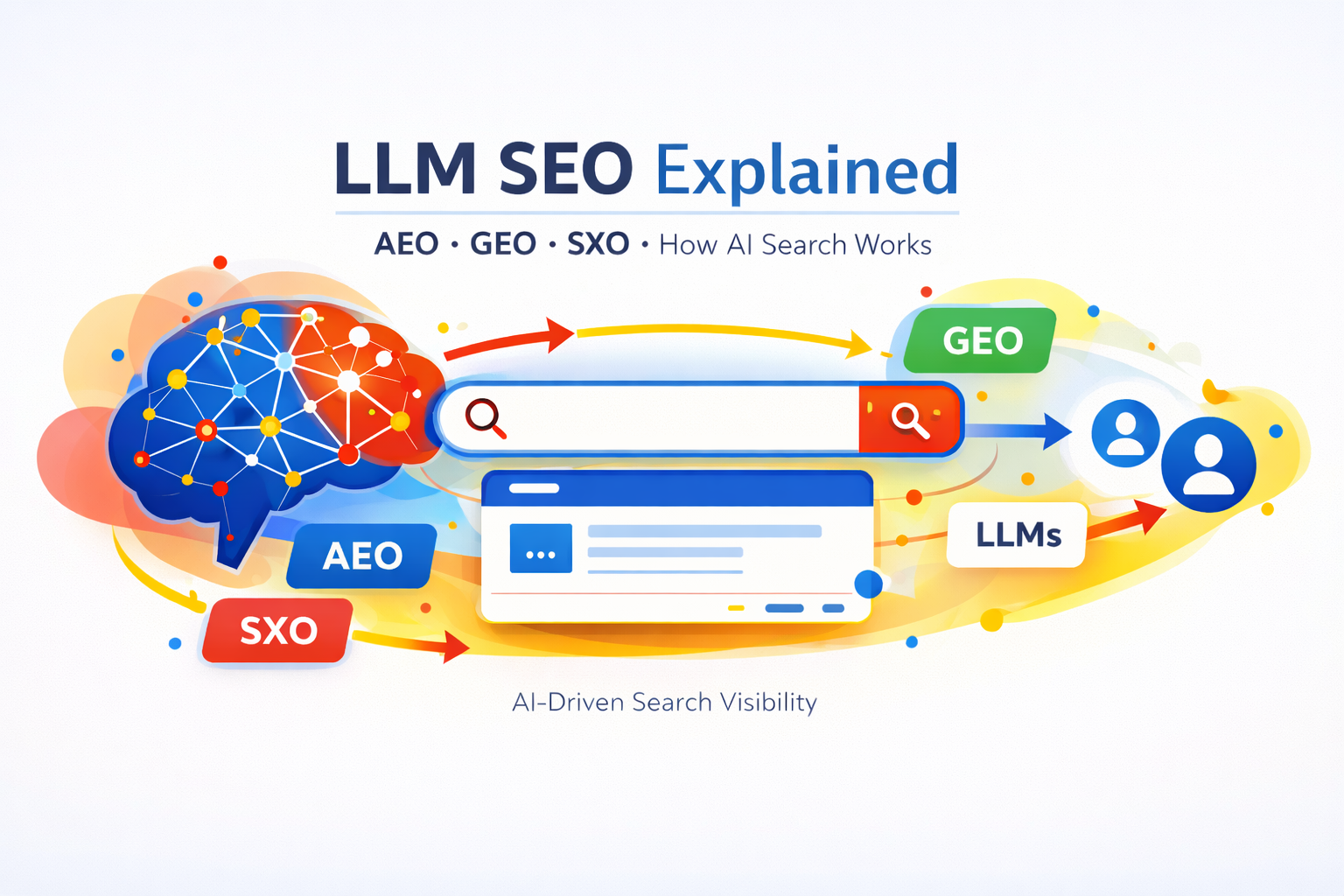
That’s where LLM-centric SEO comes in. This guide breaks down how AI systems understand content, how AEO, GEO, SEO and SXO work together and what you need to change to stay visible as search becomes more conversational and AI-driven.
TL;DR: LLM-Centric SEO Explained
- Search is now AI-first. Google AI Overviews and AI tools answer questions directly, often without clicks.
- LLM-centric SEO focuses on answers, not rankings. The goal is to be cited and mentioned by AI systems.
- SEO, AEO, GEO and SXO work together. SEO builds visibility, AEO gets answers extracted, GEO earns AI mentions and SXO keeps users engaged.
- Structure and clarity matter most. Question-based headings, direct answers, lists and tables help AI understand content.
- Authority beats keywords. Brands with consistent mentions, expertise and original data are trusted by AI.
- Success is measured by influence. Track AI citations, brand mentions, engagement quality and conversions instead of traffic alone.
Why Is Traditional SEO No Longer Enough?
For years, traditional SEO had one clear goal: rank high on Google and earn the click. But that model is breaking down. AI-powered search tools now generate answers instead of showing options and users are increasingly trusting those answers without visiting a website.
Traffic from AI tools grew by over 1,200% between mid-2024 and early 2025, while Google’s market share dipped below 90% for the first time in a decade. Younger users in particular are skipping result pages and going straight to AI tools for solutions.
This creates a new problem for brands. AI tools do not reward pages just because they rank. They surface content they understand, trust and see as authoritative. If your site is not optimized for how large language models read and interpret content, you may still rank but never appear in AI-generated answers.
Traditional SEO still matters, but on its own, it no longer guarantees visibility in an AI-first search world.
What Are the Differences Between AEO, GEO and SXO?
Modern search visibility depends on more than rankings. AEO, GEO and SXO each solve a different problem in an AI-driven search journey. Understanding where each one fits helps you apply them correctly, not randomly.

| Optimization Type | Clear Definition | Primary Goal | Works Best When Your Content |
| Answer Engine Optimization (AEO) | Optimizing content so search engines and AI tools can extract direct, accurate answers to user questions. | Get cited in Google AI Overviews, featured snippets and voice search results. | Uses question-based headings, gives clear answers early, includes FAQs, lists and tables and focuses on one intent per section. |
| Generative Engine Optimization (GEO) | Optimizing your brand and content so AI models recognize, trust and mention you in generated responses. | Appear in AI conversations from tools like ChatGPT and Perplexity. | Clearly explains who you are, builds brand authority, earns off-site mentions and shows real expertise with data and examples. |
| Search Experience Optimization (SXO) | Improving the post-click experience by combining technical SEO and user experience design. | Keep users engaged, reduce bounce rates and support long-term visibility. | Loads fast, works well on mobile, is easy to scan and navigate and fully matches user intent. |
What Is Answer Engine Optimization (AEO)?
Answer Engine Optimization (AEO) is the practice of structuring content so search engines and AI systems can extract clear, direct answers to user questions.
AEO works best when your content:
- Uses question-based headings that match real searches
- Answers the question clearly in the first few lines
- Includes FAQs, lists, tables and short explanations
- Covers one intent per section without fluff
Its primary goal is to help your content appear in Google AI Overviews, featured snippets and voice search results.
What Is Generative Engine Optimization (GEO)?
Generative Engine Optimization (GEO) focuses on making your brand and content recognizable and trustworthy to AI models so they mention you in generated answers.
GEO works best when your content:
- Clearly explains who you are and what you do
- Builds brand authority through consistent messaging
- Is supported by off-site mentions, reviews and citations
- Demonstrates real expertise with examples and data
Instead of rankings, GEO is about being included in conversations inside tools like ChatGPT and other AI assistants.
What Is Search Experience Optimization (SXO)?
Search Experience Optimization (SXO) improves how users interact with your site after discovery, combining technical SEO and user experience.
SXO works best when your content:
- Loads fast and works smoothly on mobile devices
- Is easy to scan, read and navigate
- Matches the intent promised in search or AI summaries
- Encourages engagement through clear structure and design
Strong SXO signals quality to both users and AI systems, reinforcing long-term visibility.
Used together, AEO helps AI extract answers, GEO earns trust and mentions and SXO ensures users stay engaged once they arrive.
How Do I Optimize for ChatGPT and Generative AI?
Optimizing for ChatGPT and other generative AI tools is not about chasing rankings. It’s about making your brand easy for AI to recognize, understand and trust. LLMs do not simply pull the top-ranked page. They generate answers based on authority, clarity and consistency across the web.

Why Does Brand Authority Matter More Than Keywords?
Large language models learn from patterns. They observe which brands are mentioned repeatedly, across different sources, in relevant contexts. This means a page packed with keywords but lacking credibility is easy for AI to ignore.
Brand authority works best when:
- Your brand name and positioning are consistent across your website and external platforms
- Your content shows real experience, not generic explanations
- Other trusted sites, reviews, or publications mention you, even without links
When users search or ask AI tools branded questions, it further reinforces your importance and helps models connect your brand with specific topics.
How Can You Influence AI Responses?
You can’t control AI outputs directly, but you can influence what AI systems learn from.
This works best when your content:
- Uses structured lists, comparisons and factual sections that AI can extract easily
- Includes clear “about” information, author details and context around expertise
- Covers topics completely instead of publishing isolated articles
From a technical perspective, visibility also depends on discoverability. Since ChatGPT relies heavily on Bing’s index when browsing is enabled, ensuring your site is verified and healthy in Bing Webmaster Tools increases the chances that your content is even considered.
Optimizing for generative AI is about shaping how models understand your brand over time, not gaming a single query.
How to Rank or Get Cited on AI Platforms
Ranking on AI platforms like Google AI Overviews, ChatGPT Search, Perplexity and Bing Chat works differently from traditional SEO. You are no longer optimizing for clicks. You are optimizing to become the source AI trusts and cites inside its answers.
This approach is often called Generative Engine Optimization (GEO) or Answer Engine Optimization (AEO).
The Core Principle: Answer First, Then Explain
AI models are built to summarize information. They prefer content that is clear, factual and easy to extract.
- Old SEO: Write long introductions to keep users scrolling
- AI-first SEO: Give the direct answer immediately, then add context
If the answer is buried, AI may skip your content entirely.
How to Structure Content AI Can Understand
AI does not read content like humans. It looks for patterns, entities and relationships. Structure matters more than word count.

1. Use the Inverted Pyramid
Start every section with a direct answer in 40–60 words, then expand.
Bad approach: Starting with background, history, or storytelling.
Good approach: “To fix a leaky faucet, first turn off the water supply under the sink. Remove the handle, replace the worn washer or cartridge, then reassemble and test.”
This makes your content instantly usable by AI.
2. Write Question-Based Headings
AI often generates answers by predicting responses to questions.
Avoid vague headings like:
- Conclusion
- Statistics
- Overview
Use clear questions instead:
- What is the average cost of X?
- Why does Y happen?
- How does Z work?
This aligns directly with how users ask AI tools for answers.
3. Format for Easy Extraction
Make it simple for AI to pull facts.
AI-friendly formatting includes:
- Bullet lists and numbered steps for summaries
- Tables for prices, specs, timelines, or comparisons
- Bolded key terms to highlight important entities, names and concepts
If AI can’t extract it cleanly, it won’t use it.
Authority Signals: How AI Decides Who to Trust
AI platforms reduce errors by cross-checking information across trusted sources. To get cited, your content must be verified by the wider web.
What Builds AI Trust Fast
- Digital PR and brand mentions: Appear on authoritative sites like news publications, industry blogs, Wikipedia, Crunchbase, or review platforms.
- Original data and research: Unique studies, surveys, or statistics are powerful. If you publish data no one else has, AI has no choice but to reference you.
- Quotable snippets: Write short, precise definitions or stats that AI can quote word-for-word.
Example: “LLM-centric SEO focuses on optimizing content so AI systems can understand, trust and reuse it in generated answers.”
Technical Signals That Help AI Understand Your Content
You also need to speak the machine’s language. This is where schema markup helps.
| Schema Type | Best Used For | Why It Helps AI |
| FAQ Schema | Q&A content | Feeds clear question–answer pairs directly to AI |
| Article Schema | Blog posts | Confirms author, publish date and freshness |
| Organization Schema | Homepage | Connects brand name, logo and social profiles |
Schema does not guarantee citations, but it removes ambiguity, which AI values.
Platform-Specific Optimization Tips
Different AI platforms prioritize different signals.
- Google AI Overviews: Strongly influenced by E-E-A-T. Pages ranking in the top Google results have a higher chance of being included.
- Perplexity: Prioritizes freshness and citations. Recent, data-backed content performs best. Fluff is ignored.
- ChatGPT Search: Prefers conversational, natural language. Content should sound like a helpful human, not a keyword-stuffed page.
Quick AI Optimization Checklist
- Change generic headings into clear questions
- Add a TL;DR or key takeaways at the top
- Clearly define important terms and brand descriptions
- Publish at least one piece of original research
- Format content with lists, tables and summaries
To rank or get cited on AI platforms, stop writing to rank pages and start writing to answer questions clearly, prove authority and earn trust. That’s what AI systems are trained to reward.
How Should You Measure SEO Success in an AI-Driven Search World?
If you’re still judging SEO success only by traffic numbers, it’s going to feel like something is “going wrong.” In reality, search behavior has changed. AI is answering questions upfront and your job is to make sure your brand is part of that answer, even when no click happens.

Why Is Organic Traffic Going Down?
Because users don’t need to click as often anymore. AI tools now handle the early research stage. They summarize options, explain concepts and recommend tools before a user ever lands on a website. Gartner estimates traditional search volume could drop by about 25% by 2026 and we’re already seeing this in action.
Real-world example: HubSpot saw a noticeable drop in organic visits after AI features expanded in search. But revenue didn’t fall. It increased. Why? The people who did visit were further along in the decision process. The content still influenced buyers, just earlier and more quietly.
Less traffic does not mean less impact. It means AI is doing part of the work for you.
So What Should You Measure Instead?
The key question is no longer “How many people clicked?”
It’s “Did our content influence the decision?”
Here’s what to track instead:
- Are you being mentioned by AI? Check if your brand shows up in Google AI Overviews or AI chat responses for important questions in your niche.
- Are visitors more engaged when they do arrive? Look at time on page, demo requests, signups, or purchases instead of raw sessions.
- Are branded searches increasing? When users search for your brand after seeing it mentioned by AI, that’s a strong visibility signal.
- Which pages are influencing AI answers? Some pages may drive fewer clicks but play a big role in AI summaries and recommendations.
Real-world example: Calendly often appears in AI answers about scheduling tools and meeting trends. Even if users don’t click immediately, repeated mentions build trust. When it’s time to choose a tool, Calendly feels familiar and credible.
Tools That Actually Help You Measure AI Visibility
You don’t need dozens of tools. You need the right ones.
- Google Search Console: Use it to track impressions, branded queries and visibility changes as AI Overviews expand.
- Bing Webmaster Tools: Important because ChatGPT relies on Bing’s index. If Bing can’t see your site, AI likely can’t either.
- Google Analytics 4 (GA4): Focus on engagement quality, assisted conversions and any traffic coming from AI tools.
- AI mention and brand monitoring tools: Tools like Surfer AI Tracker, Brand24, or Mention help you see where and how your brand appears in AI answers and discussions.
- SEO platforms like Ahrefs or Semrush: Use these to monitor unlinked brand mentions, authority growth and topic coverage beyond rankings.
The goal is not to chase traffic numbers anymore. It’s to measure visibility, trust and influence in a search world where AI decides what users see first.
What Does the Future of Search Look Like?
Search is no longer a destination. It’s becoming a conversation and AI is the layer controlling what gets seen, summarized and trusted. This doesn’t mean SEO is dead. It means SEO has grown up.
In the near future, users will rely even more on AI tools to:
- Compare products
- Shortlist solutions
- Learn complex topics
- Make faster decisions
That means brands won’t compete only for rankings. They’ll compete for recognition, trust and inclusion inside AI-generated answers.
The winners will be brands that:
- Create content that is easy for AI to understand and reuse
- Build authority beyond their own website
- Focus on clarity, structure and real expertise
- Measure success by influence, not just clicks
LLM-centric SEO is not a trend or a hack. It’s the natural evolution of search as AI becomes the default interface. Brands that adapt early will compound visibility over time. Those that don’t may still rank but slowly disappear from where real decisions are made.
The shift is already happening. The only question is whether your content is ready for it.
Final thoughts
Search is no longer just about rankings. It’s about being trusted enough to be included in the answer. As AI platforms shape how people discover information, brands that focus only on traditional SEO will slowly lose visibility where decisions actually happen. LLM-centric SEO brings everything together by prioritizing clarity, authority and experience over tactics that no longer scale.
The good news is this shift rewards quality. When you answer questions clearly, structure content for AI understanding and build real brand authority, visibility compounds across search and AI platforms. This is not a short-term trend or a workaround. It’s the next phase of search.
Start optimizing for answers, not clicks and you won’t just keep up with change. You’ll stay ahead of it.
FAQs
LLM SEO is the practice of optimizing content so large language models like ChatGPT and Google AI Overviews can understand, trust and cite it in generated answers. It focuses on clarity, authority, structure and brand recognition rather than clicks alone.
SEO improves visibility in traditional search results. AEO optimizes content to be used as direct answers in AI summaries and snippets. GEO focuses on getting brands mentioned inside AI-generated responses by building authority, entity signals and trust across the web.
SEO stands for Search Engine Optimization and focuses on ranking in search results. AEO stands for Answer Engine Optimization and focuses on structuring content so AI tools and search engines can extract and display direct answers to user questions.
The four main types of SEO are On-page SEO (content and keywords), Off-page SEO (links and brand mentions), Technical SEO (site performance and crawlability) and SXO or User Experience SEO (engagement, usability and conversion-focused optimization).